Sturdy staking method
Install slim stakes and soft ties when plants are 15–20 cm tall, then add a second tie point halfway up the stem to prevent wind snap just before flowering.

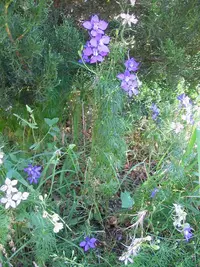
Doubtful knight's-spur (Delphinium ajacis) is an annual flowering plant grown mainly for its tall, colorful flower spikes. It belongs to the buttercup family and is often used in cottage gardens and seasonal borders.
Plants usually form upright stems with deeply divided, lacy leaves and dense clusters of blue, pink, purple, or white flowers. Blooms attract bees and other pollinators and are often used as cut flowers.
This species is native to parts of the Mediterranean region but is widely cultivated in temperate gardens. It prefers sunny, open sites with well-drained, fertile soil, and regular moisture.
Gardeners who learn how to care for doubtful knight's-spur find it moderately easy, though plants can be sensitive to strong wind, waterlogging, and very hot, humid conditions.

Care Difficulty
Moderate Care

Light Preference
Full Sun

Water Requirements
Regular Water

Temperature Preference
Cool Climate

Hardiness Zone
3–7

Soil Texture
Loamy, Sandy, Organic-rich

Soil pH
Acidic (5.5–6.5), Slightly acidic (6.5–7.0)

Soil Drainage
Moist but well-drained

Fertilization
Light (every 4–6 weeks)
Scan your plant to receive care tips personalized for your specific plant
Available on iOS and Android
Delphinium ajacis thrives in bright outdoor conditions with several hours of direct light each day.
This plant prefers evenly moist, well-drained soil and does not tolerate extremes of dryness or saturation.
This cool-season annual grows best in mild temperatures and struggles with extreme heat or hard frost.
This species grows best in moderately humid air but usually copes with typical outdoor conditions.
This plant prefers deep, cool, well‑drained soil that still holds consistent moisture.
This species can be grown in containers if the pot is deep, stable, and drains very efficiently.
Delphinium ajacis responds well to moderate feeding that supports tall stems and abundant blooms without forcing soft, weak growth.
Pruning Delphinium ajacis helps maintain strong, upright plants and encourages a longer flowering season.
This species is usually grown as a bedding or border annual, so transplanting young plants matters more than long-term repotting.
Delphinium ajacis is most often propagated from seed, which allows a wide range of flower colors and forms.
As a cool-season annual or short-lived perennial, Delphinium ajacis usually needs only minimal winter care in mild climates.

Plant Health Check
Not sure what's wrong with your plant? Check your plant's health inside the app.
This species is considered a complex of garden-origin hybrids closely related to wild Mediterranean larkspurs, rather than a single naturally occurring wild species. Many seed strains sold under this name trace back to selections and hybridization done in European cottage gardens over several centuries.
Its flowers have a long, backward-pointing spur that contains nectar, accessed mainly by long-tongued bees and some butterflies. The spur length and shape in this species differ from several other cultivated larkspurs, giving it a characteristic profile in side view.
All parts of the plant contain diterpenoid alkaloids similar to those found in other Delphinium species, which are poisonous if eaten by humans or livestock. Seeds and young plants tend to have especially concentrated toxin levels and should be handled with care around grazing animals.

The specific epithet ajacis refers to Ajax, a hero from Greek mythology, reflecting an old European tradition of linking larkspurs with classical legends and symbolic meanings in historic gardens.
Lack of flowers often comes from nutrient imbalance, excessive nitrogen, or insufficient light. Overcrowding, old exhausted plants, or stress from heat, drought, or root disturbance also reduce bloom. Deadheading spent spikes can direct energy to new flower production.
Keep your plants happy and healthy with plant identification, disease detection, and easy care guidance.