Mounting on Slabs
Consider mounting plants on cork or hardwood slabs with a thin pad of long-fiber sphagnum around the roots to mimic their natural epiphytic habit and improve air movement around new roots.

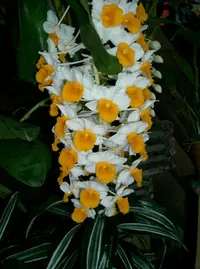
Dendrobium thyrsiflorum is an epiphytic orchid, usually growing on trees, with arching canes and dense clusters of soft yellow and white flowers. It forms clumps of upright pseudobulbs that lose some leaves before flowering, giving it a distinctive seasonal rhythm.
In nature, it occurs in humid, montane forests of Southeast Asia, where it experiences bright but filtered light and good air movement. It is considered a moderately demanding orchid, as it needs stable conditions, a clear dry and wet cycle, and careful watering. For those learning how to care for Dendrobium thyrsiflorum, consistent light, humidity, and a free-draining orchid mix are the main priorities.

Care Difficulty
Hard Care

Light Preference
Partial Shade

Water Requirements
Moderate Water

Temperature Preference
Tropical / Frost Sensitive

Hardiness Zone
11–12

Soil Texture
Sandy, Rocky, Organic-rich

Soil pH
Acidic (5.5–6.5)

Soil Drainage
Well-drained

Fertilization
Moderate (every 2–4 weeks)
Scan your plant to receive care tips personalized for your specific plant
Available on iOS and Android
This orchid prefers bright, filtered light that mimics high-elevation forest margins.
This species prefers evenly moist but fast-draining conditions with a brief dry-down between waterings.
This orchid is a cool- to intermediate-growing species that dislikes temperature extremes.
This orchid prefers consistently moist air, so humidity is a key factor in Dendrobium thyrsiflorum care.
This species grows best in a very airy, fast-draining orchid substrate rather than standard potting soil.
This orchid is well suited to container culture, including hanging baskets and slatted orchid pots.
This orchid benefits from light, consistent feeding during active growth for reliable flowering.
This species needs only light, targeted pruning to maintain health and flowering.
This epiphytic orchid prefers tight quarters and infrequent repotting to avoid growth setbacks.
This orchid is most reliably propagated by division rather than seed or cuttings.
This species is not frost hardy and requires cool, frost-free winter conditions.

Plant Health Check
Not sure what's wrong with your plant? Check your plant's health inside the app.
This orchid is native to montane forests from the eastern Himalayas through northern Indochina, typically growing at mid‑elevations where nights are cool and light is bright but filtered by tree canopies.
It produces dense, hanging racemes that can carry dozens of flowers at once, each with white petals and a contrasting deep yellow-orange lip, giving a distinctive two‑tone appearance.
Mature canes often shed their leaves before flowering, so the showy blooms emerge on mostly leafless, arching pseudobulbs, which is a characteristic trait used by botanists to distinguish this species from related dendrobiums.

In its natural habitat, this species is usually epiphytic on mossy tree branches, where its dangling flower clusters are positioned below the canopy to attract pollinators moving along forest light gaps rather than deep inside the shade.
Lack of flowering is usually due to insufficient light, no cool, drier winter rest, or overfertilizing with nitrogen. Provide bright conditions, a distinct cooler rest period, and use a balanced orchid fertilizer at modest strength.
Keep your plants happy and healthy with plant identification, disease detection, and easy care guidance.