Staggered Container Lifting
If growing in pots, start raising the corms closer to the soil surface over 2–3 seasons by repotting a little higher each time, which helps the dramatic spathe display fully and reduces rot around the neck of the corm.

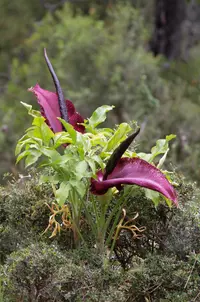
Common dracunculus (Dracunculus vulgaris), also called dragon arum, is a tuberous perennial from the arum family. It produces a large, dramatic purple spathe surrounding a dark central spadix.
The plant has bold, divided leaves on sturdy stems and typically grows from underground tubers that rest dormant in the dry season. It is native to the Mediterranean region and nearby areas, where it thrives in rocky, well-drained sites.
Its strong odor during flowering attracts pollinating insects but can be unpleasant in small spaces, which affects how to care for common dracunculus in gardens or containers. It prefers bright light, moderate moisture during active growth, and loose, draining soil.

Care Difficulty
Moderate Care

Light Preference
Partial Shade

Water Requirements
Moderate Water

Temperature Preference
Cool Climate

Hardiness Zone
6–9

Soil Texture
Loamy, Sandy, Organic-rich

Soil pH
Acidic (5.5–6.5), Slightly acidic (6.5–7.0)

Soil Drainage
Moist but well-drained

Fertilization
Minimal (feed rarely)
Scan your plant to receive care tips personalized for your specific plant
Available on iOS and Android
This species prefers bright, gentle light rather than intense, all-day sun.
Watering should support a moist but not saturated root zone during the active growing season.
This plant is a cool- to warm-temperate species with a dormant period that follows seasonal temperature changes.
This species tolerates a wide humidity range and usually does not need special humidity management.
Dracunculus vulgaris prefers loose, humus-rich, sharply drained soil that never stays waterlogged.
This species grows reliably in containers when tuber depth and drainage are managed carefully.
Dracunculus vulgaris is a hardy tuber that benefits from light feeding rather than heavy fertilization.
Pruning needs for Dracunculus vulgaris are minimal and focus on sanitation rather than shaping.
This species grows from tubers, so transplanting or dividing clumps is more common than frequent repotting.
Dracunculus vulgaris is most reliably propagated by tuber division, with seed used mainly for breeding or patience-demanding projects.
This plant is reasonably cold-hardy in many temperate climates, but tubers benefit from some winter protection in colder regions.

Plant Health Check
Not sure what's wrong with your plant? Check your plant's health inside the app.
The inflorescence produces a strong smell similar to rotting meat for a short period after opening, which attracts carrion-feeding flies that act as pollinators.
The central spadix can warm itself above ambient air temperature during peak flowering, which helps volatilize its odor and further attracts insect pollinators.
This species is native to the eastern Mediterranean and Balkans, where it often grows on rocky limestone slopes, scrub, and woodland edges, showing a clear preference for calcareous soils.
Historical records show that this species was cultivated in European gardens at least since the 16th century, mainly as a botanical curiosity due to its dramatic purple spathe and unusual pollination strategy, long before its horticultural requirements were formally described in modern Dracunculus vulgaris plant care literature.
Lack of flowering usually comes from immature tubers, insufficient winter chill, or recent division. Overly shaded positions and nutrient-poor or very dry spring conditions also reduce bloom. Allow tubers to size up undisturbed and maintain steady spring moisture.
Keep your plants happy and healthy with plant identification, disease detection, and easy care guidance.