Mark Dormant Clumps
After the foliage dies back in fall, mark the clump edges with discreet stakes so you avoid disturbing the rhizomes when digging, mulching, or planting nearby in winter and early spring.

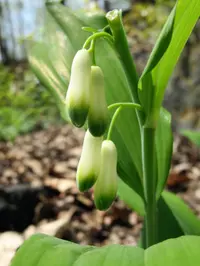
Smooth Solomon's seal (Polygonatum biflorum) is a hardy woodland perennial grown mainly for its graceful, arching stems and clean foliage. It forms clumps that slowly spread over time, creating a soft, layered look in shade gardens.
The stems carry paired, bell-shaped white flowers that hang beneath the leaves in spring, followed by small bluish-black berries. It is native to eastern North America, where it grows in deciduous forests and along shaded slopes.
This species suits gardeners who prefer low-maintenance plants, as it is long-lived and not demanding once established. To care for smooth Solomon's seal, provide consistent moisture, dappled light, and humus-rich, well-drained soil.

Care Difficulty
Easy Care

Light Preference
Partial Shade

Water Requirements
Moderate Water

Temperature Preference
Cold Hardy

Hardiness Zone
3–8

Soil Texture
Loamy, Silty, Organic-rich

Soil pH
Acidic (5.5–6.5), Slightly acidic (6.5–7.0)

Soil Drainage
Moist but well-drained

Fertilization
Minimal (feed rarely)
Scan your plant to receive care tips personalized for your specific plant
Available on iOS and Android
This woodland perennial prefers cool, dappled light that mimics forest edge conditions.
This rhizomatous perennial prefers steadily moist but not saturated soil during the growing season.
This hardy woodland plant tolerates a wide temperature range but grows best in cool to mild conditions.
This woodland perennial grows well in 40–60% humidity and usually adapts to typical home air levels.
This species prefers loose, humus-rich soil that stays evenly moist yet drains freely.
This species can be grown successfully in containers when the pot is deep and moisture is carefully managed.
This woodland perennial needs only light feeding, as Polygonatum biflorum is adapted to modest, organic-rich soils.
Pruning needs for Polygonatum biflorum are minimal and mainly focused on cleanliness and plant health.
This species is usually grown in the ground, so transplanting well-established clumps matters more than repotting.
Most home gardeners use division as the primary method for Polygonatum biflorum propagation.
This woodland perennial is cold hardy in much of North America and usually needs little specific winter attention.

Plant Health Check
Not sure what's wrong with your plant? Check your plant's health inside the app.
This species naturally forms graceful, arching stems 30–90 cm tall that emerge from creeping rhizomes and create loose colonies in deciduous forests of eastern North America.
Its name biflorum refers to the typical arrangement of 2 tubular, greenish-white flowers hanging together from each leaf node on the underside of the arching stems.
After flowering in spring, it produces small blue-black berries in late summer that are eaten by birds and small mammals, contributing to seed dispersal in woodland ecosystems.

Indigenous peoples in eastern North America traditionally used the starchy rhizomes of smooth Solomon's seal as a wild food source, carefully distinguishing it from the toxic and superficially similar false Solomon's seal (Maianthemum racemosum).
This species spreads slowly by rhizomes, forming clumps over several years rather than rapidly taking over. It can be nudged along by dividing crowded clumps, but usually remains well behaved in typical shade borders.
Keep your plants happy and healthy with plant identification, disease detection, and easy care guidance.