


Encourage Compact Growth
Pinch back soft, leggy shoot tips in late winter or very early spring to keep plants low, dense, and heavily flowering rather than straggly and open.

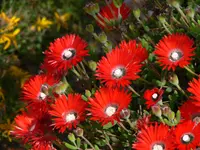
Royal dewflower, Drosanthemum speciosum, is a compact, mat-forming succulent from the dry, rocky regions of South Africa. It is grown mainly for its carpets of bright daisy-like flowers.
The plant has small, fleshy leaves that store water and shimmer slightly, and it stays relatively low to the ground. In warm, sunny conditions it can cover slopes, rock gardens, or edges with dense color.
This species suits gardeners who want a drought-tolerant plant that prefers full sun, fast-draining soil, and light but not constant watering. Those who care for royal dewflower usually find it easy if frost and prolonged wet soil are avoided.

Care Difficulty
Easy Care

Light Preference
Full Sun

Water Requirements
Low Water

Temperature Preference
Warm Climate

Hardiness Zone
9–11

Soil Texture
Sandy, Loamy, Rocky

Soil pH
Slightly acidic (6.5–7.0), Neutral (7.0)

Soil Drainage
Well-drained

Fertilization
Minimal (feed rarely)
Scan your plant to receive care tips personalized for your specific plant
Available on iOS and Android
This South African succulent thrives in strong light and needs full sun to flower well.
This drought-tolerant succulent prefers infrequent, deep watering and fast-drying soil.
This species prefers warm, dry conditions and does poorly in prolonged cold or frost.
This succulent prefers relatively dry air and is comfortable in 30–50% humidity.
This species needs very free-draining, sandy growing medium to prevent root rot.
This species is well suited to container growing in sunny, dry locations.
This succulent needs only light feeding, so focus on modest nutrition during its active spring–summer growth.
Pruning helps Drosanthemum speciosum stay compact, encourage flowering, and maintain a tidy mat of growth.
This species is usually grown in the ground, but container plants or young starts benefit from timely transplanting.
New plants are most often raised from softwood cuttings or seeds taken from established Drosanthemum speciosum clumps.
This succulent tolerates only mild frost, so winter care focuses on keeping roots dry and avoiding hard freezes.

Plant Health Check
Not sure what's wrong with your plant? Check your plant's health inside the app.
The leaf surfaces are dotted with tiny bladder-like cells that swell with mucilage and water, giving the plant its sparkling, dewy appearance in strong sunlight and leading to the common name royal dewflower.
In its native South African fynbos, flowers commonly open fully in bright, warm midday conditions and close again in dull, cool, or evening conditions, which helps protect the reproductive parts from chill and moisture.
In fire-prone fynbos habitats, populations often regenerate from seed after burns, benefiting from increased light and reduced competition in the years following a fire.

Royal dewflower is one of the more cold-tolerant South African ice plants and has been successfully grown in mild Mediterranean-climate coastal regions outside its native range, where its brilliant carpets of orange-red blooms are used as a striking, drought-tolerant groundcover.
Flowering often decreases when plants are overcrowded, poorly drained, or pruned at the wrong time. Light levels might be fine, yet old woody stems dominate. Light trimming after flowering and occasional renewal pruning usually restore blooms over the next season.
Keep your plants happy and healthy with plant identification, disease detection, and easy care guidance.

Blue Arabis
Arabis caerulea

Euphorbia officinarum
Euphorbia officinarum
 POPULAR
African Milk Tree
Euphorbia trigona
flower of an hour
Hibiscus trionum

Hoffmann's teddybear cholla
Cylindropuntia fosbergii

rosy sundew
Drosera hamiltonii
Sierra columbine
Aquilegia pubescens

leatherleaf spiderwort
Tradescantia crassifolia