Pinch Early Growth
When seedlings reach 10–15 cm tall, pinch out the soft tip above a leaf node to encourage branching and produce more flowering shoots over the season.

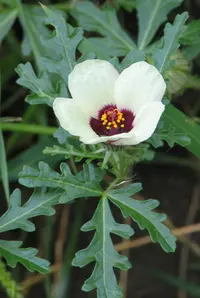
Flower of an hour (Hibiscus trionum) is a fast-growing annual or short-lived perennial from the mallow family, valued for its pale, short-lived blooms with dark centers. The flowers usually open for only a few hours on sunny days, but the plant produces many buds so it can bloom steadily over the season.
It has a branching, bushy habit with light green, lobed leaves and decorative inflated seed pods that extend its ornamental interest. Native to parts of southern Europe, Africa, and Asia, it has naturalized in many warm and temperate regions, sometimes behaving like a mild garden self-seeder.
This species is generally easy to grow, provided it receives plenty of sun, well-drained soil, and moderate moisture. For gardeners learning how to care for flower of an hour, it offers a forgiving introduction to annual hibiscus relatives.

Care Difficulty
Easy Care

Light Preference
Full Sun

Water Requirements
Moderate Water

Temperature Preference
Warm Climate

Hardiness Zone
5–9

Soil Texture
Sandy, Loamy, Organic-rich

Soil pH
Acidic (5.5–6.5), Slightly acidic (6.5–7.0)

Soil Drainage
Well-drained

Fertilization
Minimal (feed rarely)
Scan your plant to receive care tips personalized for your specific plant
Available on iOS and Android
Hibiscus trionum thrives in bright, open sites with strong sun exposure for best flowering.
This species prefers evenly moist, well-drained soil that never stays saturated for long.
This annual hibiscus grows best in warm conditions without frost or extreme temperature swings.
This annual shrub handles a wide humidity range but performs best with moderate moisture in the air.
This species prefers light, well-drained soil that does not stay wet after rain or watering.
This species is well-suited to container growing for seasonal display on patios and balconies.
Hibiscus trionum benefits from light feeding during its active growing season for stronger flowering and foliage.
Thoughtful pruning keeps Hibiscus trionum compact, healthy, and flowering well.
This short-lived species is usually grown as a bedding or wildflower plant, so transplanting is more common than repotting.
Hibiscus trionum is most often propagated from seed, which germinates reliably under warm, bright conditions.
This annual or tender short-lived perennial usually dies back in freezing winters, so long-term winter care is limited.

Plant Health Check
Not sure what's wrong with your plant? Check your plant's health inside the app.
Each flower of Hibiscus trionum typically opens for only part of a single day, often just 1–2 hours in bright sun before closing and fading, which explains the common name flower of an hour.
The flowers have pale cream to yellow petals with a sharply contrasting dark purple center, which likely acts as a nectar guide to help pollinators locate the reproductive parts of the flower more efficiently.
Mature seed capsules dry and split open, releasing many small seeds that can be scattered by wind, water, or soil disturbance, which helps the species spread readily as a self-seeding annual in open, sunny habitats.

Hibiscus trionum is thought to be native to parts of the Mediterranean and eastern Africa but has become widely naturalized across multiple continents, including North America, where it can behave as a volunteer weed in disturbed soils, crop fields, and roadsides.
This species self-seeds freely, so it can appear in new spots each year. It is usually manageable in small gardens if spent seed pods are removed before they dry and drop, limiting unwanted seedlings.
Keep your plants happy and healthy with plant identification, disease detection, and easy care guidance.