Secure Mounting Base
Attach the rhizomes to a stable, rot-resistant mount such as cork, hardwood slab, or a slatted basket, using soft plant ties or nylon fishing line, and check yearly that the fastenings are not cutting into new growth.

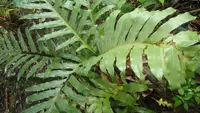
Oakleaf fern, Drynaria quercifolia, is an epiphytic fern that often grows on tree trunks or rock surfaces rather than in typical garden soil. It forms two types of fronds: sterile, brown, shield-like fronds that cling to the support, and longer, green, lobed fronds that resemble oak leaves.
This fern is native to tropical regions of Asia and parts of Australia, where it thrives in warm, humid forests with filtered light. Its epiphytic nature and need for consistent moisture make it moderately challenging for beginners, especially in dry indoor air. Understanding how to care for Oakleaf fern involves providing stable humidity, gentle airflow, and a loose, well-drained mounting or potting medium.

Care Difficulty
Moderate Care

Light Preference
Partial Shade

Water Requirements
Moderate Water

Temperature Preference
Tropical / Frost Sensitive

Hardiness Zone
11–12

Soil Texture
Loamy, Rocky, Organic-rich

Soil pH
Acidic (5.5–6.5), Slightly acidic (6.5–7.0)

Soil Drainage
Moist but well-drained

Fertilization
Light (every 4–6 weeks)
Scan your plant to receive care tips personalized for your specific plant
Available on iOS and Android
This epiphytic fern prefers bright, filtered light that mimics dappled forest shade.
Moist but not waterlogged conditions support healthy frond and rhizome growth.
Stable warm conditions support active growth and prevent stress damage.
This epiphytic fern prefers consistently moist air and reacts quickly to dry indoor conditions.
This fern prefers a loose, airy, organic-rich substrate that mimics decaying leaf litter on tree trunks or rocks.
This species adapts well to container or mounted culture when the container mimics its natural, shallow epiphytic habitat.
This epiphytic fern has modest nutrient needs but responds well to light, consistent feeding in active growth.
Pruning Drynaria quercifolia focuses on hygiene and maintaining a tidy, healthy clump rather than shaping.
This fern is usually grown mounted or in shallow baskets, so transplanting focuses on refreshing its support and medium.
This species is most reliably propagated by rhizome division, while spore propagation is slow and more advanced.
This tropical fern is frost sensitive and needs protection anywhere winter temperatures drop near freezing.

Plant Health Check
Not sure what's wrong with your plant? Check your plant's health inside the app.
This species grows two distinct frond types, including brown, sterile fronds that overlap and form a basket-like nest to trap leaf litter and moisture around the rhizome.
The trapped leaf litter in the nest of sterile fronds slowly decomposes into humus, allowing the plant to absorb extra nutrients that are scarce on tree trunks and rocky surfaces.
In its native range from India through Southeast Asia to northern Australia, this fern often grows as an epiphyte high on tree branches, where good air movement and filtered light mimic its natural conditions for growing Oakleaf fern.

In some parts of Southeast Asia, large clumps of this fern are traditionally mounted on wooden boards or coconut husks and hung on house walls or trees as living ornaments, valued for the layered, antler-like outline of their fertile fronds.
Browning usually comes from very dry air, irregular watering, or strong sun. Fronds may also brown and shed naturally as new ones form. Trim dead tissue, maintain even moisture, and increase humidity around the plant.
Keep your plants happy and healthy with plant identification, disease detection, and easy care guidance.