Crown mulching
Maintain a 5–8 cm layer of shredded leaf mulch around but not over the fern crown to keep roots cool, conserve soil moisture, and reduce weed competition without risking rot at the growing point.

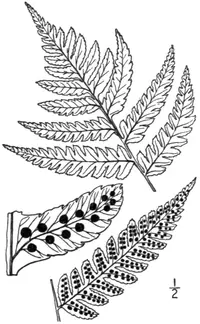
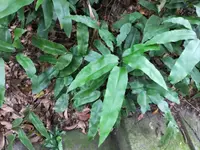
Clinton's woodfern (Dryopteris clintoniana) is a hardy, clump-forming fern native to moist woods, swamps, and stream edges in northeastern North America. It is typically found in cool, shaded environments with consistent moisture.
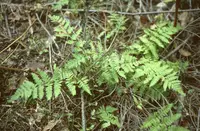
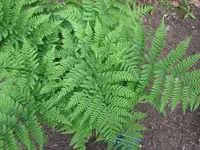
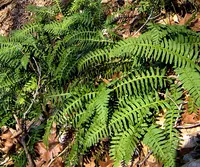
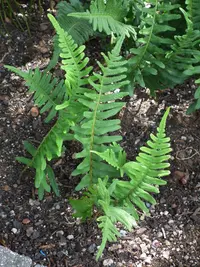
The plant forms upright, arching fronds that create a dense, vase-shaped crown with a strong, architectural look. Fronds are deep green and leathery, giving good texture in shaded borders or naturalized woodland plantings.
This species prefers humus-rich, consistently moist, but well-drained soil and protection from hot, direct sun. Once the site is right, it is relatively low-maintenance, and understanding how to care for Clinton's woodfern mainly involves keeping the root zone cool and evenly moist.

Care Difficulty
Moderate Care

Light Preference
Partial Shade

Water Requirements
Keep Soil Moist

Temperature Preference
Cold Hardy

Hardiness Zone
3–7

Soil Texture
Loamy, Silty, Organic-rich

Soil pH
Acidic (5.5–6.5), Slightly acidic (6.5–7.0)

Soil Drainage
Moist but well-drained

Fertilization
Minimal (feed rarely)
Scan your plant to receive care tips personalized for your specific plant
Available on iOS and Android
This hardy woodland fern prefers cool, shaded light conditions that mimic a moist forest floor.
This fern requires consistently moist but not waterlogged soil to maintain healthy fronds and roots.
This species is a cold-hardy fern that thrives in cool to mild outdoor conditions.
This fern prefers consistently moist, cool air with moderate to high humidity.
This fern needs consistently moist, humus-rich soil that drains freely yet never dries out completely.
This fern adapts well to container growing outdoors when moisture and stability are managed carefully.
This hardy woodland fern needs only modest feeding when grown in average, humus-rich soil.
Pruning Dryopteris clintoniana focuses on hygiene and maintaining a tidy clump rather than shaping.
This fern is most often grown in the ground, with transplanting done only when crowding or poor siting becomes a problem.
Propagation of this fern is usually done by division rather than from spores, which are slower and more technical.
This cold-hardy fern tolerates typical winters in much of its range and usually needs minimal intervention.

Plant Health Check
Not sure what's wrong with your plant? Check your plant's health inside the app.
This fern is a naturally occurring hybrid between Dryopteris cristata and Dryopteris goldiana, combining the more upright habit of D. cristata with the larger frond size of D. goldiana.
It typically grows in moist, base-rich or calcareous soils that contain higher levels of calcium carbonate, such as fens and wet woods over limestone or other alkaline substrates.
The species has a scattered and localized distribution in eastern North America and is considered uncommon or of conservation concern in several states due to habitat loss and wetland alteration.

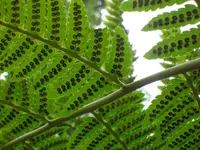
Clinton's woodfern often forms stable, long-lived hybrid populations that reproduce mainly by spores rather than ongoing hybridization events, which indicates that it behaves as a distinct, self-perpetuating species despite its hybrid origin.
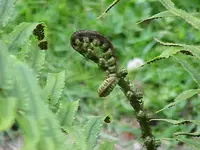
This species is semi-evergreen in many temperate climates. Fronds often stay green through mild winters but may bronzy or die back in colder areas, then resprout from the crown in spring with fresh growth.
Keep your plants happy and healthy with plant identification, disease detection, and easy care guidance.