


Stabilize Young Trunks
Stake young plants with 2–3 sturdy posts placed just outside the root zone and use soft, wide ties to prevent wind rock, which helps the trunk root in firmly and reduces later leaning.

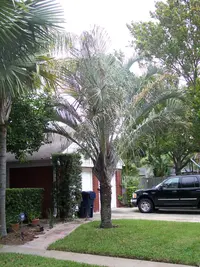
Triangle palm (Dypsis decaryi) is a distinctive palm species recognized for its three-sided crown of fronds arranged along a triangular trunk. It is a medium to large, slow-growing palm typically used as a specimen in warm landscapes or spacious indoor settings.
This species is native to arid regions of Madagascar, where it grows in rocky, well-drained soils with strong sunlight. Its tolerance of sun, wind, and short dry periods makes it relatively resilient, though consistent warmth and good drainage are important. Understanding how to care for Triangle palm starts with providing bright light, infrequent but deep watering, and airy, free-draining soil.

Care Difficulty
Moderate Care

Light Preference
Full Sun

Water Requirements
Moderate Water

Temperature Preference
Tropical / Frost Sensitive

Hardiness Zone
10–11

Soil Texture
Sandy, Loamy, Rocky

Soil pH
Acidic (5.5–6.5), Slightly acidic (6.5–7.0)

Soil Drainage
Well-drained

Fertilization
Light (every 4–6 weeks)
Scan your plant to receive care tips personalized for your specific plant
Available on iOS and Android
This palm thrives in bright, open exposures that mimic its native, sun-soaked habitat.
This species prefers infrequent, deep watering with time for the soil to partially dry between soakings.
This palm performs best in consistently warm, frost-free conditions.
This palm handles a wide humidity range but grows best with moderately dry air.
This species prefers sharply draining, sandy soil that still holds some moisture around the roots.
This palm is suitable for container growing, especially in cooler climates or where space is limited.
Balanced, modest feeding supports healthy growth of Dypsis decaryi without forcing weak, lush tissue.
Pruning Dypsis decaryi is mainly cosmetic and helps maintain a clean, balanced crown.
Transplanting or repotting Dypsis decaryi is infrequent but important when roots outgrow the available space.
Propagation of Dypsis decaryi is typically done from seed and is considered slow and specialized.
Cold sensitivity makes focused winter care important for Dypsis decaryi outside frost-free climates.

Plant Health Check
Not sure what's wrong with your plant? Check your plant's health inside the app.
This palm arranges its leaf bases in three distinct vertical rows along the trunk, creating a triangular crown when viewed from above, which is unusual among palms that typically form a more circular canopy.
It occurs naturally only in a limited region of southern Madagascar, growing in dry, open habitats with rocky, well-drained soils and experiencing strong sun and seasonal drought.
Unlike many clumping palms, this species usually forms a single, upright trunk with persistent leaf bases that create a neatly patterned, gray-green surface over time.

In its native range in southern Madagascar, this species is considered vulnerable in the wild due to habitat loss and fragmentation, yet it has become widely cultivated internationally as an ornamental palm in warm climates.
Growth is moderate rather than fast. In warm climates with good care, expect about 15–30 cm of trunk growth per year. Container plants usually grow more slowly due to restricted root space and less stable conditions.
Keep your plants happy and healthy with plant identification, disease detection, and easy care guidance.


lucuba palm
Dypsis madagascariensis
Tillandsia ixioides
Tillandsia ixioides
 POPULAR
Never Never Plant
Ctenanthe setosa
double coconut
Lodoicea maldivica
Ecuadorian Tagua Palm
Phytelephas aequatorialis

Tillandsia juncea
Tillandsia juncea
Dypsis lastelliana
Dypsis lastelliana
New Zealand Bamboo Orchid
Earina mucronata