Deep container choice
Use an extra-deep, rigid container with more height than width to accommodate the very long taproot and reduce circling roots, and only move up 1 pot size at a time to limit transplant stress.

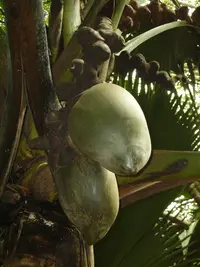
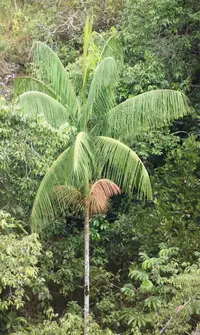
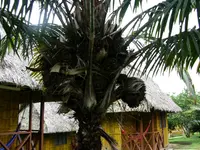
The double coconut, Lodoicea maldivica, is a very slow-growing palm famous for producing the largest seed in the plant kingdom. It forms a massive, solitary trunk topped with dense, arching fronds that create a heavy, tropical canopy as it matures.
This species is native to the Seychelles islands, where it grows in humid, coastal forests with consistently warm conditions. Its slow growth, sensitivity to disturbance, and need for stable warmth and moisture make it challenging to cultivate, especially outside the tropics.
Gardeners who want to learn how to care for double coconut should know it prefers bright light, high humidity, and deep, free-draining, organic-rich soil from an early age.

Care Difficulty
Hard Care

Light Preference
Partial Shade

Water Requirements
Keep Soil Moist

Temperature Preference
Tropical / Frost Sensitive

Hardiness Zone
12–13

Soil Texture
Sandy, Loamy, Organic-rich

Soil pH
Slightly acidic (6.5–7.0), Neutral (7.0)

Soil Drainage
Moist but well-drained

Fertilization
Minimal (feed rarely)
Scan your plant to receive care tips personalized for your specific plant
Available on iOS and Android
This slow-growing palm needs bright, gentle light similar to dappled tropical forest conditions.
This palm prefers evenly moist but never waterlogged soil, with a clear wet–dry rhythm around the root zone.
This species is a strict tropical palm that depends on stable warmth and freedom from cold stress.
This species prefers sustained high humidity to mimic its Seychelles habitat.
This palm needs deep, airy, sandy-loam substrate that drains freely yet retains steady moisture.
This palm is only marginally suitable for containers and remains practical in pots only while young.
Lodoicea maldivica grows slowly and needs only light, careful feeding in cultivation.
Lodoicea maldivica requires minimal pruning focused on hygiene rather than shaping.
Transplanting double coconut is rare and should be done only when clearly necessary due to its deep taproot.
Propagation of Lodoicea maldivica is almost exclusively from its large, slow‑germinating seeds and is highly specialized.
This ultra‑tropical palm is very frost‑sensitive and needs strong winter protection outside its native climate.

Plant Health Check
Not sure what's wrong with your plant? Check your plant's health inside the app.
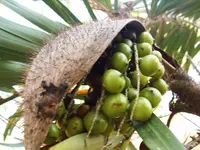
This species produces the largest known seed in the plant kingdom, with individual seeds often exceeding 10 kg and developing inside a huge, double-lobed fruit over many years.
Flowers are unisexual and produced on separate male and female trees, and a single seed can take close to 1 year to germinate and another 6–7 years to form a mature fruit, making population recovery very slow.
The species is naturally confined to only a few granitic islands of the Seychelles, where it forms distinctive palm forest and strongly influences soil structure and nutrient cycles through its massive leaf litter and fruit.

Genetic and ecological studies show that the double coconut evolved in isolation for millions of years on the Seychelles, making it a classic example of an oceanic island endemic that has no close living relatives elsewhere on Earth.
This species grows extremely slowly, especially in containers. The seedling stage can last many years, and trunk formation is gradual. Patience is essential when growing double coconut, as visible height gains often take several seasons.
Keep your plants happy and healthy with plant identification, disease detection, and easy care guidance.