Early spine management
Select and retain only a few strong basal shoots and carefully remove weak, crowded, or dangerously positioned spiny suckers when young to reduce future hazards and improve clump structure.

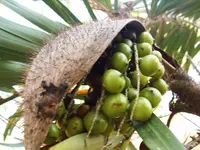
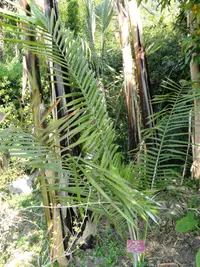
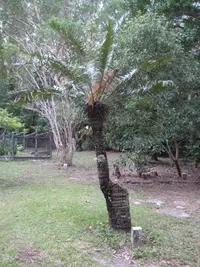
Guinea bactris (Bactris guineensis) is a spiny, clustering palm native to tropical regions of the Americas, especially coastal and lowland forests. It often forms dense thickets with multiple slender stems.
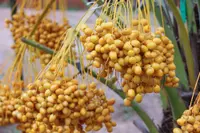
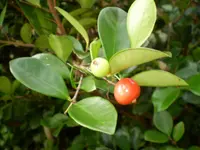
The plant typically carries narrow, feather-like leaves and small, rounded fruits that attract wildlife. Its stiff spines and clumping habit make it more suitable for spacious outdoor plantings than for casual indoor use.
This species prefers warm, humid conditions, consistent moisture, and well-drained, organic-rich soil. Gardeners who understand how to care for Guinea bactris usually focus on providing protection from cold and strong, drying winds.

Care Difficulty
Hard Care

Light Preference
Full Sun

Water Requirements
Regular Water

Temperature Preference
Tropical / Frost Sensitive

Hardiness Zone
11–12

Soil Texture
Sandy, Loamy, Organic-rich

Soil pH
Acidic (5.5–6.5), Slightly acidic (6.5–7.0)

Soil Drainage
Moist but well-drained

Fertilization
Minimal (feed rarely)
Scan your plant to receive care tips personalized for your specific plant
Available on iOS and Android
This tropical palm prefers bright, indirect light with some protection from intense midday sun.
This species prefers consistently moist, but not waterlogged, soil.
This palm thrives in warm, frost-free tropical to subtropical conditions.
This palm prefers fairly humid air and reacts poorly to prolonged dryness indoors.
This species needs deep, moist, well-aerated soil that drains freely yet does not dry out quickly.
This palm can be grown in large containers if given enough root depth and stable support.
This palm benefits from light, balanced feeding in cultivation but is not a heavy feeder.
Pruning is mainly used to keep this palm tidy and safe rather than to shape it heavily.
This clumping palm is usually grown in the ground, so focus on careful transplanting rather than frequent repotting.
This species is usually propagated from seed, which can be slow but is the most reliable method.
This tropical palm is frost sensitive and needs protection in regions with cool or freezing winters.

Plant Health Check
Not sure what's wrong with your plant? Check your plant's health inside the app.
This palm naturally occurs along Caribbean and Atlantic coasts of Central and northern South America, where it forms dense, spiny thickets in lowland forests, mangroves, and coastal scrub.
Its small dark drupes are an important food source for birds and mammals, which consume the pulp and help disperse the seeds through the surrounding forest.
In parts of its range it grows on sandy, sometimes saline soils close to the sea, showing notable tolerance to coastal conditions compared with many other understory palms.

Archaeobotanical and ethnobotanical studies show that Indigenous communities in northern South America have long used this palm for both food (its edible fruits) and as a source of tough, spiny stems for fencing and living barriers, taking advantage of its naturally clumping, defensive growth habit.
Growth is moderate rather than rapid. In suitable tropical or subtropical conditions, it may add roughly 30–60 cm per year. Cooler temperatures, inadequate moisture, poor soil fertility, or root restriction in containers will slow development noticeably.
Keep your plants happy and healthy with plant identification, disease detection, and easy care guidance.