Rhizome crowd management
Lift and divide rhizomes every 3–4 years in late winter or early spring, replanting only the healthiest, firm sections to prevent overcrowding and maintain strong, flowering clumps.

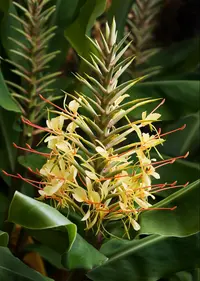
Kahila garland-lily, Hedychium gardnerianum, is a tropical rhizomatous perennial in the ginger family grown for its tall, lush foliage and highly fragrant flowers. It forms clumps of upright stems with broad, green leaves and showy yellow flowers with long red stamens.
This species is native to the Himalayas but is widely grown in warm and mild climates as an ornamental. In suitable conditions it spreads quickly, which makes it vigorous but also potentially invasive outdoors.
It is generally considered moderately easy to grow, provided it has consistent moisture, rich well-drained soil, and bright, filtered light. Understanding these basic needs helps owners know how to care for Kahila garland-lily in gardens or large containers.

Care Difficulty
Moderate Care

Light Preference
Partial Sun

Water Requirements
Keep Soil Moist

Temperature Preference
Warm Climate

Hardiness Zone
8–11

Soil Texture
Loamy, Silty, Organic-rich

Soil pH
Acidic (5.5–6.5), Slightly acidic (6.5–7.0)

Soil Drainage
Moist but well-drained

Fertilization
Moderate (every 2–4 weeks)
Scan your plant to receive care tips personalized for your specific plant
Available on iOS and Android
This ginger prefers bright conditions with protection from harsh midday sun.
This rhizomatous perennial prefers consistently moist but not waterlogged soil.
This species thrives in warm, frost-free conditions with mild temperature swings.
This species prefers consistently moist air and benefits from higher humidity in most homes.
This rhizomatous ginger grows best in deep, loose, moisture-retentive but free-draining soil.
This species adapts well to container growing when given enough root space and careful moisture management.
This ginger benefits from steady nutrition during its active growing season for strong canes and flowering.
Targeted pruning keeps Hedychium gardnerianum tidy and supports healthy flowering.
This robust ginger spreads by rhizomes and benefits from periodic division or transplanting when overcrowded.
This species is most commonly propagated by division of its fleshy rhizomes.
This tropical ginger has limited frost tolerance and needs winter planning in cool climates.

Plant Health Check
Not sure what's wrong with your plant? Check your plant's health inside the app.
This ginger species opens many of its yellow flowers at dusk and releases a strong, sweet scent that intensifies at night, which helps attract moth pollinators rather than daytime insects.
Its bright red seed arils are adapted to attract birds, which eat the fleshy covering and disperse the hard seeds, a classic example of bird-mediated seed dispersal in montane Asian forests.
It is naturally found in the eastern Himalayas of India and Nepal, where it grows in cool, moist habitats at higher elevations, tolerating cooler conditions than many other tropical gingers.

In regions such as Hawaii, New Zealand, and the Azores, this species has become a serious invasive plant, forming dense stands that outcompete native vegetation and are now the focus of long-term eradication and containment programs.
This species spreads by fleshy rhizomes that expand outward each year, forming dense clumps. In mild, wet climates it can become difficult to control and may require root barriers, regular division, or removal of unwanted shoots.
Keep your plants happy and healthy with plant identification, disease detection, and easy care guidance.