Staking in Wind
In open or windy sites, insert discreet slender stakes on the windward side early in the season and loosely tie stems with soft ties to prevent lodging and snapping once the heavy flower heads develop.

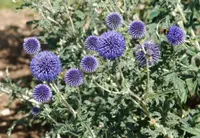
Southern globethistle, Echinops ritro, is a clump-forming perennial grown mainly for its spherical, steel-blue flower heads. It typically forms upright stems with spiny, deeply divided gray-green leaves that give the plant a distinctive, architectural look.
This species is native to dry, open habitats in southern and eastern Europe and parts of western Asia, where it thrives in poor, rocky soils. Its drought tolerance, sun-loving nature, and low nutrient needs make it relatively easy to grow in many temperate gardens.
Gardeners who want to learn how to care for southern globethistle should note that it prefers full sun, well-drained soil, and only moderate watering once established.

Care Difficulty
Easy Care

Light Preference
Full Sun

Water Requirements
Low Water

Temperature Preference
Cold Hardy

Hardiness Zone
3–9

Soil Texture
Sandy, Loamy, Rocky

Soil pH
Slightly acidic (6.5–7.0), Slightly alkaline (7.0–7.5)

Soil Drainage
Well-drained

Fertilization
Minimal (feed rarely)
Scan your plant to receive care tips personalized for your specific plant
Available on iOS and Android
Echinops ritro thrives in strong sun and forms the best flowering stems under open, bright conditions.
Echinops ritro prefers relatively dry conditions and is sensitive to excess moisture around its roots.
This species is a hardy perennial that tolerates a wide range of outdoor temperatures once established.
Humidity is rarely a concern for Echinops ritro, which is adapted to dry, open habitats.
Echinops ritro prefers lean, mineral-rich soil with sharp drainage to prevent root problems.
This species can be grown in containers if the pot is prepared for its deep, sturdy root system.
This drought-tolerant perennial, including southern globethistle, benefits from modest, controlled feeding during active growth.
Targeted pruning helps Echinops ritro maintain a tidy shape and sustain flowering.
This taprooted perennial is best planted in a permanent ground position and moved only when necessary.
Echinops ritro is commonly propagated by seed or careful division of established clumps.
This species is generally cold hardy and requires little winter care in most temperate climates.

Plant Health Check
Not sure what's wrong with your plant? Check your plant's health inside the app.
The flower heads of this species are near-perfect spheres made up of many small tubular florets, each capable of producing nectar and pollen, which makes the plant highly efficient at attracting pollinators from all directions.
Studies from European meadow systems show that its blue flower globes are an important nectar source for bees and butterflies in midsummer, when other wildflowers may already have finished blooming.
This species develops a deep, strong taproot in well-drained soils, which allows established plants to tolerate summer drought better than many other ornamental perennials.

In traditional European field margins and steppe-like grasslands, this species often persists for decades on the same site, forming stable clumps that act as long-term resources for pollinators and as a structural element in semi-natural plant communities.
Lack of flowering usually comes from too much shade, overly rich or wet soil, or young plants not yet mature. Avoid heavy fertilizing, ensure full sun, and do not move or divide clumps too frequently.
Keep your plants happy and healthy with plant identification, disease detection, and easy care guidance.