


Provide vertical support
Mount the plant on cork, tree fern, or rough bark, or secure it to a narrow, tall stake so the long, reed-like canes grow upright and the pendulous roots and flowers have space to hang naturally.

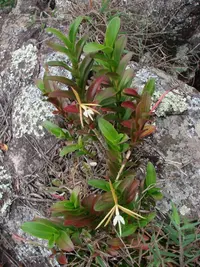
The night scented orchid, Epidendrum nocturnum, is a tropical epiphytic orchid that often grows on trees in warm, humid forests of Central and South America. It produces slender, reed-like stems with narrow leaves and delicate, pale flowers that release a strong fragrance at night.
This species prefers bright, filtered light, good air movement, and evenly moist but free-draining growing media. It is considered moderately challenging, as it reacts quickly to poor humidity, low light, or stale, compacted substrate.
Understanding how to care for night scented orchid starts with providing stable warmth, consistent moisture without waterlogging, and protection from harsh, direct sun.

Care Difficulty
Moderate Care

Light Preference
Partial Shade

Water Requirements
Regular Water

Temperature Preference
Tropical / Frost Sensitive

Hardiness Zone
11–12

Soil Texture
Sandy, Organic-rich

Soil pH
Acidic (5.5–6.5), Slightly acidic (6.5–7.0)

Soil Drainage
Moist but well-drained

Fertilization
Light (every 4–6 weeks)
Scan your plant to receive care tips personalized for your specific plant
Available on iOS and Android
This epiphytic orchid prefers bright, gentle light similar to bright forest edges.
This species prefers evenly moist conditions with brief drying periods around the roots.
This orchid grows best in warm, stable conditions with mild nighttime drops.
This species prefers consistently moist air but adapts moderately to typical indoor humidity.
This epiphytic orchid needs a loose, airy medium that drains very quickly and never compacts.
This orchid suits container growing when the pot supports its tall, reed-like growth and quick drainage.
This orchid benefits from light, consistent feeding during active growth but reacts poorly to heavy fertilizer.
Pruning needs for Epidendrum nocturnum are modest and focus on cleanliness rather than shaping.
Repotting helps maintain healthy roots and good aeration for this epiphytic orchid.
Propagation of Epidendrum nocturnum is usually done vegetatively rather than from seed at home.
This tropical orchid is frost-sensitive and needs warm, stable conditions in winter.

Plant Health Check
Not sure what's wrong with your plant? Check your plant's health inside the app.
This species opens its long, narrow petals widely at night and releases a strong, sweet fragrance after dark, an adaptation that targets nocturnal moth pollinators rather than daytime insects.
Its flowers have a very long, tubular floral structure (the nectar spur and column region) that matches the tongues or proboscises of specific night-flying moths, showcasing a classic example of coevolution between orchid and pollinator.
The species occurs naturally from southern Mexico through Central America and the Caribbean into northern South America and Florida, often growing as an epiphyte on trees in humid lowland forests and swampy habitats.

Unlike many showy orchids, this species typically produces relatively few flowers at a time, but each flower can last for several weeks, allowing a single bloom to contribute to pollination over an extended period without high energy cost to the plant.
Lack of blooms usually comes from insufficient nighttime temperature drop, too little light, or low humidity. Mature stems also need a slight drier rest between growth phases. Consistent, moderate feeding supports flower production without forcing weak spikes.
Keep your plants happy and healthy with plant identification, disease detection, and easy care guidance.


Philodendron
Philodendron 'Florida Ghost'
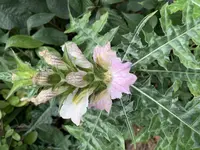
Mountain thistle
Acanthus montanus
lacy phacelia
Phacelia tanacetifolia
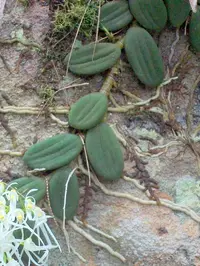
tongue orchid
Dendrobium linguiforme
 POPULAR
Bamburanta
Ctenanthe lubbersiana
 POPULAR
Caladium lindenii
Caladium lindenii
bunchleaf penstemon
Penstemon heterophyllus
 POPULAR
Philodendron verrucosum
Philodendron verrucosum