Vertical support setup
Mount the plant on a sturdy stake or orchid support and loosely tie the canes with soft ties so the tall, upright stems stay stable and the flower spikes are not bent or broken by their own weight.

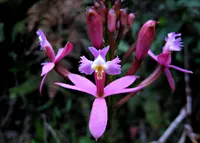
Lopsided star orchid, Epidendrum secundum, is a tropical epiphytic orchid that often grows on trees or rocks in warm, humid regions of Central and South America. It forms upright, cane-like stems with narrow leaves and showy flower spikes.
Its blooms are grouped on one side of the stem, giving the inflorescence a distinctive uneven or lopsided look in shades of pink, purple, or occasionally white. The plant is generally considered moderately easy for those familiar with basic orchid care.
It prefers bright, filtered light, good air movement, and a very free-draining orchid substrate. Understanding how to care for Lopsided star orchid starts with avoiding soggy roots and providing steady warmth and humidity.

Care Difficulty
Moderate Care

Light Preference
Partial Sun

Water Requirements
Moderate Water

Temperature Preference
Tropical / Frost Sensitive

Hardiness Zone
10–12

Soil Texture
Sandy, Loamy, Organic-rich

Soil pH
Acidic (5.5–6.5), Slightly acidic (6.5–7.0)

Soil Drainage
Well-drained

Fertilization
Light (every 4–6 weeks)
Scan your plant to receive care tips personalized for your specific plant
Available on iOS and Android
This orchid prefers bright, filtered light similar to open woodland or bright balcony conditions.
This species prefers evenly moist but fast-draining conditions rather than constant wetness.
This orchid grows best in warm to intermediate conditions with mild night drops.
This orchid benefits from moderately humid air but copes with typical indoor levels if watering is consistent.
Epidendrum secundum prefers a very airy, fast-draining medium rather than dense, compacted soil.
This species adapts well to container growing when pot choice supports its upright, reed-like growth habit.
This orchid benefits from light, consistent feeding to support flowering without stressing the roots.
Targeted pruning keeps Epidendrum secundum tidy and channels energy into new flowering growth.
This orchid prefers snug conditions but benefits from periodic repotting to refresh its airy medium.
Propagation of this species is commonly done from keikis and by division rather than from seed.
This orchid is not frost tolerant and needs warm, protected conditions in winter.

Plant Health Check
Not sure what's wrong with your plant? Check your plant's health inside the app.
This orchid is naturally found in high-altitude campos rupestres and cloud-forest margins of eastern Brazil, often growing on exposed rocky outcrops where nights are cool and humidity is high.
Its inflorescence carries many small flowers crowded to one side of the stem, a feature that inspired the common name lopsided star orchid and reflects a distinctive asymmetry within the genus.
Wild populations show notable variation in flower color, ranging from pink and lilac to deeper magenta tones, with a contrasting, often fringed lip that helps guide pollinators toward the nectar.

This species belongs to the so-called reed-stem epidendrums, forming upright, cane-like stems that can live and flower repeatedly over several years, so a single clump can create dense, long-lived colonies in its native habitat.
Lack of flowering usually comes from insufficient light, too little fertilizer, or no temperature difference between day and night. A slight dry rest after growth and balanced feeding often improves Epidendrum secundum care and flower production.
Keep your plants happy and healthy with plant identification, disease detection, and easy care guidance.