


Golden Pothos (Epipremnum aureum) Light Needs

Golden Pothos grows best in bright, indirect light, with brief gentle morning sun tolerated in most indoor settings.

Light Preference

Bright Indirect Light

Epipremnum aureum Light Requirements

Golden Pothos is native to tropical forest habitats in the South Pacific, where it climbs trees and receives filtered light under a canopy. Young growth often starts in deeper shade, while climbing stems may reach brighter, dappled light rather than open all-day sun. Indoors, this translates to strong ambient light without harsh midday rays. Its preferred light is bright, indirect light.

  • Ideal exposure:

    Epipremnum aureum needs about 6–8 hours of bright, indirect or filtered light daily, including up to 1–2 hours of gentle direct morning sun.

  • Direct sun:

    Brief early sun is tolerated, but full sun or hot afternoon rays can scorch exposed leaves.

  • Lower light:

    Shade and low indoor light are survivable, but growth usually slows and variegation becomes less distinct.

  • Best timing:

    Morning light is safer than west-facing afternoon sun, especially near glass in summer.

Indoors, the best placement gives bright ambient light while protecting leaves from harsh direct sun.

NConditional
North-facing window:

Use a bright, unobstructed north window only if new growth stays compact and variegation holds.

EBest
East-facing window:

Place it within a few feet of an east window where soft morning sun reaches the leaves.

SConditional
South-facing window:

Keep it several feet back from a south window or behind a sheer curtain to avoid harsh direct rays.

WConditional
West-facing window:

Set it back 4–6 ft from a west window or filter the afternoon sun with a sheer curtain.

Adjust placement if leaves lean strongly toward the window or show pale, scorched patches.

Strong direct sun can injure exposed leaves.

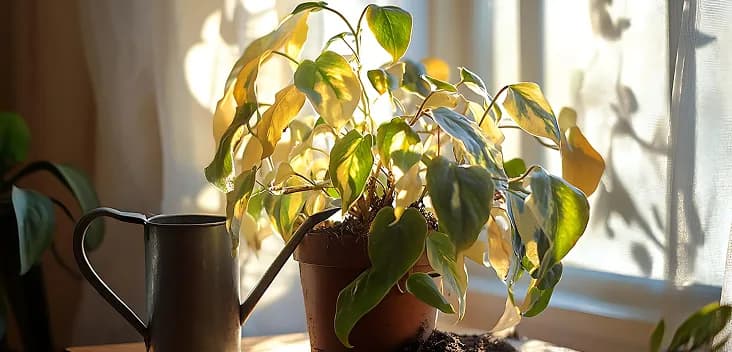
Bleached patches:

Pale cream or whitish areas may appear where leaves face the glass after sudden direct sun.

Tan scorch marks:

Dry tan or brown spots can form on the most exposed sections, often with sharp edges.

Crisp thin tissue:

Damaged areas may feel papery and stay visible even after the plant is moved.

Faded variegation:

Harsh light can wash out normal contrast instead of making the leaf pattern clearer.

Move Epipremnum aureum out of harsh afternoon sun right away. Place it in bright filtered light and leave damaged leaves until healthy new growth can replace them.

Low light is tolerated, but it is not the best long-term setting. Watch new growth patterns during spring and summer.

  • Long gaps:

    Vines may stretch with wider spaces between leaves as stems reach toward the brightest area.

  • Smaller leaves:

    New leaves may emerge noticeably smaller than older leaves on the same vine.

  • Weaker variegation:

    Green areas often become more dominant when the plant is kept too far from a light source.

  • Leaning growth:

    Stems may angle strongly toward the window instead of growing evenly around the pot.

  • Slow active growth:

    During the growing season, Epipremnum aureum may produce fewer new leaves than expected.

Move it closer to a bright window, but avoid sudden full sun. Rotate the pot after relocation to keep new growth balanced.

When ideal light is limited, choose the brightest spot that does not receive harsh afternoon sun. Accept slower growth in a dim room rather than placing the plant in full sun.

Rotate the pot a quarter turn every 1–2 weeks if stems lean toward the light. Keep leaves out of hot direct rays by using a sheer curtain or moving the pot back.

A dark corner is unsuitable for long-term display because new growth will stretch and variegation can fade.

Get Personalized Care Plan

Scan your plant to receive care tips personalized for your specific plant

FAQ

The best light for Golden Pothos is bright, indirect light for most of the day. It can tolerate some shade, but brighter filtered light supports fuller growth and clearer leaf patterning.

Everything About Golden Pothos

More Plant Light Guides

Get the Botan App

Discover how to care for your plants with Botan.

Botan app identifying a plant with a phone camera
12 Best Plants That Repel Spiders For Your Home and Garden

8 min read · 24 Jul 2026

12 Best Plants That Repel Spiders For Your Home and Garden

Spiders constantly appear in places you don't want them. A few common plants can help repel them using scent alone. Here are 12 options suitable for both indoors and outdoors, plus care tips for each.

Plant Recommendations
12 Best Plants That Repel Spiders For Your Home and Garden
Best Time to Mow Lawn – A Complete Guide

5 min read · 10 Aug 2026

Best Time to Mow Lawn – A Complete Guide

Explore when to mow your lawn for its health and a pleasant green color. Find out the best time for this task during the summer heat, and follow practical tips for correctly cutting the grass, and learn common mistakes to avoid.

Plant Care
Best Time to Mow Lawn – A Complete Guide
How to Repot a Plant: A Step-by-Step Guide

7 min read · 28 May 2026

How to Repot a Plant: A Step-by-Step Guide

In spring, many plants need repotting—an essential part of care. To avoid stress, consider the plant’s type and size. This article offers a step-by-step guide for repotting indoors or outdoors and shows how to check plant health and get care tips using the Botan app.

Plant Care
How to Repot a Plant: A Step-by-Step Guide