Stable container weight
Use a wide, heavy pot or add a top layer of coarse gravel so the tall, narrow stems are less likely to tip over when bumped or in strong indoor drafts.

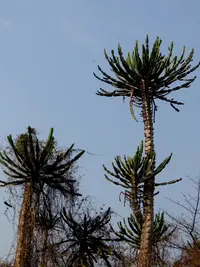
The candelabra tree, Euphorbia candelabrum, is a succulent tree that resembles a many-armed cactus but belongs to the spurge family. It forms tall, upright, branching columns with ridged, green stems and sparse small leaves at the tips. In nature it occurs in dry, rocky regions of eastern Africa, where it is adapted to intense sun and limited rainfall. Its slow growth, drought tolerance, and architectural form appeal to collectors, but its toxic milky sap requires careful handling. For anyone learning how to care for Candelabra tree, it helps to know that it prefers strong light, minimal watering, and sharply draining, gritty soil.

Care Difficulty
Moderate Care

Light Preference
Full Sun

Water Requirements
Low Water

Temperature Preference
Tropical / Frost Sensitive

Hardiness Zone
10–12

Soil Texture
Sandy, Loamy, Rocky

Soil pH
Slightly acidic (6.5–7.0), Slightly alkaline (7.0–7.5)

Soil Drainage
Well-drained

Fertilization
Minimal (feed rarely)
Scan your plant to receive care tips personalized for your specific plant
Available on iOS and Android
This succulent tree needs strong, consistent light to maintain compact, healthy growth.
This drought-adapted species requires infrequent but thorough watering and very fast drainage.
This species prefers warm, dry conditions and is sensitive to cold and frost.
This species is adapted to arid conditions and usually does not require special humidity management indoors.
This drought-adapted succulent needs very fast-draining, mineral-rich soil to avoid root and stem rot.
This species can be grown in containers, especially in cooler climates or where in-ground planting is not practical.
This drought-adapted succulent needs only light feeding to maintain steady growth in containers or nutrient-poor substrates.
Pruning Euphorbia candelabrum is mainly corrective and should be done sparingly for safety and plant health.
Container-grown plants and young outdoor specimens tolerate infrequent but careful transplanting when they outgrow their space.
This species is usually propagated by experienced growers from cuttings or seeds due to its size and caustic sap.
Cold protection is important, as this succulent tree is highly frost sensitive and best suited to mild, arid climates.

Plant Health Check
Not sure what's wrong with your plant? Check your plant's health inside the app.
This East African tree forms dense, branching candelabra-shaped crowns that create crucial shade and perching spots for birds in very arid, rocky habitats where few woody plants can survive.
The plant produces a thick, white, highly irritating latex that deters most herbivores and can cause severe skin and eye irritation in humans on contact.
In the wild it commonly anchors itself on basalt and other rocky outcrops at mid to high elevations, using a shallow but wide-spreading root system adapted to thin, fast-draining soils.

Historical accounts from parts of East Africa describe its toxic latex being used on arrow tips and as a component of traditional boundary hedges, where the combination of dense branching and caustic sap discouraged both animals and people from crossing.
Growth is slow to moderate. In warm, arid landscapes it may add 10–25 cm per year and eventually reach 4–8 m, but in containers it often stays much smaller and more columnar.
Keep your plants happy and healthy with plant identification, disease detection, and easy care guidance.