

Rotate For Symmetry
Turn the pot 90° every 2–3 weeks so the head develops evenly and the twisted stem does not lean permanently toward the light source.

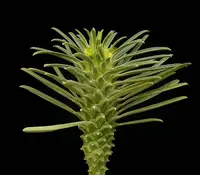
Ostrich Noors (Euphorbia clandestina) is a small, shrubby succulent from South Africa, known for its upright, jointed, cactus-like stems. It often forms a clumping mound with a knobby, segmented look and sparse, short-lived leaves near the stem tips.
In habitat it grows in dry, rocky areas with strong light and very well-drained soils. Its slow growth, drought tolerance, and minimal foliage make it relatively easy for patient growers who avoid overwatering. Those learning how to care for Ostrich Noors should focus on bright light, modest watering, and a gritty, fast-draining mix.

Care Difficulty
Moderate Care

Light Preference
Full Sun

Water Requirements
Low Water

Temperature Preference
Tropical / Frost Sensitive

Hardiness Zone
10–11

Soil Texture
Sandy, Loamy, Rocky

Soil pH
Slightly acidic (6.5–7.0), Neutral (7.0)

Soil Drainage
Well-drained

Fertilization
Minimal (feed rarely)
Scan your plant to receive care tips personalized for your specific plant
Available on iOS and Android
This succulent prefers bright, open conditions that mimic a sunny, rocky habitat.
This drought-tolerant succulent stores water in its stems and needs infrequent, careful watering.
This species prefers warm, dry conditions and is sensitive to cold, especially in wet soil.
This Euphorbia prefers fairly dry air and does not need elevated humidity.
This species needs a very fast-draining, mineral-rich medium similar to cactus or succulent mixes.
This compact succulent is well suited to container growing when drainage and stability are controlled.
Euphorbia clandestina grows well with light, measured feeding rather than heavy fertilization.
Euphorbia clandestina needs minimal pruning, mainly for safety and shape control.
Container-grown plants benefit from infrequent but careful repotting to refresh the soil and manage root health.
New Euphorbia clandestina plants are most often raised from stem cuttings taken in warm conditions.
This species is not very frost tolerant and benefits from simple winter protection in colder climates.

Plant Health Check
Not sure what's wrong with your plant? Check your plant's health inside the app.
This species has a swollen underground caudex that slowly becomes exposed as the plant ages, giving the stem its characteristic knobbly, segmented look above the soil line.
In its native South African habitats, the jointed, thorn-tipped stems visually blend with surrounding spiny shrubs, which likely helps reduce herbivore browsing.
Euphorbia clandestina occurs naturally in restricted areas of the Western and Eastern Cape in South Africa, mainly on rocky slopes where drainage is very rapid and soils are shallow.

The yellowish cyathia, which are the specialized cup-shaped inflorescences typical of the genus Euphorbia, are produced in tight clusters near the stem tips and are pollinated by small insects attracted to their nectar rather than to showy petals.
Lack of flowering usually comes from insufficient light, cool temperatures, or a pot that is too large. Ensure strong light, stable warmth, and avoid overfertilizing with nitrogen, which promotes stem growth instead of blooms.
Keep your plants happy and healthy with plant identification, disease detection, and easy care guidance.

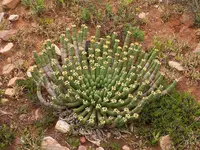
Medusa’s head
Euphorbia caput-medusae

Acanthocalycium spiniflorum
Acanthocalycium spiniflorum
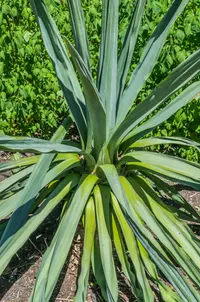
weeping furcraea
Furcraea parmentieri
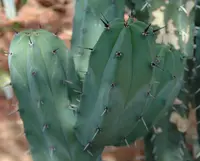
Bilberry Cactus
Myrtillocactus geometrizans
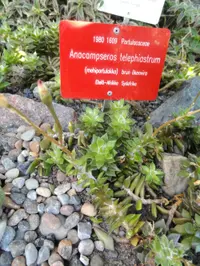
Large-flowered Sandrose
Anacampseros telephiastrum
 POPULAR
Sand Rose
Anacampseros rufescens
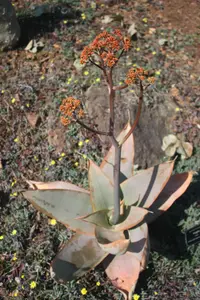
Coral aloe
Aloe striata
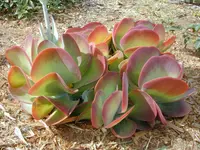 POPULAR
Flapjacks plant
Kalanchoe thyrsiflora