Staking young stems
Install a sturdy stake or rebar on the windward side of young plants and loosely tie the main stems with soft ties to prevent breakage as they elongate and fill with heavier, watery sap.

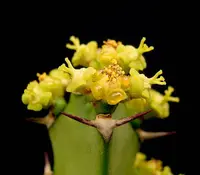
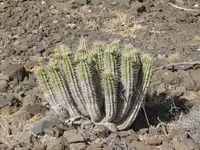
Valleybush euphorbia (Euphorbia grandidens) is a succulent shrub or small tree with thick, angular green stems and sparse leaves. It often forms candelabra-like branches as it matures.
This species is native to arid and semi-arid regions of southern Africa, where it grows on rocky slopes and dry scrub. Its drought tolerance and slow to moderate growth rate make it relatively low-maintenance in suitable conditions.
Spiny stems and latex sap are its main protective traits, which also influence how to care for valleybush euphorbia safely. It generally prefers bright light, fast-draining soil, and infrequent watering that allows the roots to dry between waterings.

Care Difficulty
Easy Care

Light Preference
Full Sun

Water Requirements
Low Water

Temperature Preference
Tropical / Frost Sensitive

Hardiness Zone
10–12

Soil Texture
Sandy, Loamy, Rocky

Soil pH
Slightly acidic (6.5–7.0), Neutral (7.0)

Soil Drainage
Well-drained

Fertilization
Minimal (feed rarely)
Scan your plant to receive care tips personalized for your specific plant
Available on iOS and Android
This succulent shrub prefers bright, open conditions similar to its native dry scrub habitats.
This drought-adapted species stores water in its succulent stems and needs infrequent, careful watering.
This species prefers warm, arid conditions and is sensitive to extended cold or frost.
This Euphorbia tolerates a wide humidity range and usually does not need special humidity management indoors.
This species needs a very fast-draining, mineral-rich substrate to avoid root and stem rot.
This species is suitable for container growing, especially in regions with frost or very wet winters.
This drought-adapted succulent shrub needs modest feeding in containers but usually manages in the ground with minimal fertilizer.
Thoughtful pruning keeps Euphorbia grandidens compact, stable, and safe to handle.
This species is usually grown in the ground; container plants or young specimens tolerate infrequent, careful transplanting.
New Euphorbia grandidens plants are most often raised from stem cuttings taken in warm weather.
This succulent shrub is frost-sensitive and needs protection in climates colder than its native range.

Plant Health Check
Not sure what's wrong with your plant? Check your plant's health inside the app.
This South African species naturally forms a many-branched, candelabra-shaped shrub or small tree up to several meters tall, with thick, water-storing, photosynthetic stems instead of leafy branches for most of the year.
Its sharp spines usually occur in pairs along the ribs and are modified remnants of old leaf bases, an adaptation that helps reduce herbivory while also minimizing water loss in its semi-arid habitat.
In its native range it often grows on rocky slopes and dry thickets, relying on succulent stems, a reduced leaf phase, and a shallow but wide-spreading root system to exploit brief rainfall events, which is a key point in Euphorbia grandidens plant care in cultivation.

In parts of southern Africa, hedges of this species are traditionally planted as living fences because its dense, spiny, drought-tolerant growth habit and irritating latex sap make an effective barrier against livestock and human intrusion.
This species performs best outdoors in warm, dry climates where it receives strong light and ample space for its shrubby, tree-like form. Indoors it survives only in very bright, dry conditions, making long‑term valleybush euphorbia indoor care somewhat challenging.
Keep your plants happy and healthy with plant identification, disease detection, and easy care guidance.