


Pot-depth control
Choose a shallow, wide pot and keep roots slightly confined, as this slows overly lush growth and helps maintain the characteristic compact mound of heads when growing False Milkballs.

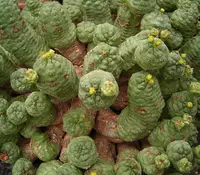
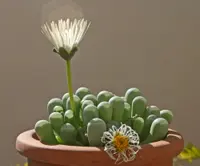
False milkballs (Euphorbia pseudoglobosa) is a small, clumping succulent from arid regions of South Africa. It forms tight mounds of rounded, green, ball-like stems with tiny leaves and occasional small yellow flowers.
Its growth is slow and compact, making it suitable for containers, windowsills, and rock garden displays. The plant stores water in its swollen stems, so it is quite drought-tolerant and sensitive to overwatering.
This species prefers bright light, very well-draining mineral soil, and careful watering with good drying between soakings. With these basics in mind, it is relatively easy to care for False Milkballs.

Care Difficulty
Moderate Care

Light Preference
Full Sun

Water Requirements
Low Water

Temperature Preference
Tropical / Frost Sensitive

Hardiness Zone
10–11

Soil Texture
Sandy, Rocky, Loamy

Soil pH
Slightly acidic (6.5–7.0), Neutral (7.0)

Soil Drainage
Well-drained

Fertilization
Minimal (feed rarely)
Scan your plant to receive care tips personalized for your specific plant
Available on iOS and Android
This compact succulent prefers bright, indirect light with limited harsh midday sun.
This drought-tolerant succulent requires thorough but infrequent watering with fast drainage.
This species grows best in warm, dry conditions with good protection from cold and frost.
This succulent tolerates dry indoor air well, so humidity is rarely a concern.
This species needs a very fast-draining, mineral-rich substrate to prevent root and stem rot.
This compact caudiciform succulent is well suited to container culture.
This compact succulent benefits from light feeding but is sensitive to excess salts and rich soils.
Pruning needs for Euphorbia pseudoglobosa are minimal and mainly hygiene focused.
This slow-growing succulent prefers tight pots and infrequent disturbance.
New plants are usually produced from offsets and stem sections rather than seed.
This species is not frost hardy and needs careful winter handling, especially in containers.

Plant Health Check
Not sure what's wrong with your plant? Check your plant's health inside the app.
This species forms a swollen, tuberous rootstock that sits partly underground and stores water, giving rise to its clustered globular stems above the soil surface.
It grows as a tight, low mound of small, rounded, grey-green stems that can slowly merge into a cushion-like mat only a few centimeters tall, which helps it handle strong light and drying winds in habitat.
The plant carries tiny, short-lived leaves that quickly dry and fall, leaving much of the photosynthesis to the green stem surface, an adaptation to arid conditions that reduces water loss.

In habitat, this species often grows partly buried in gritty, mineral-rich soil, so that only the upper parts of its globular stems are visible above ground, which helps protect the plant body from temperature extremes and desiccation.
This species blooms best when given a distinct cool, dry rest in winter and plenty of light. Excessive watering, frequent repotting, or high nitrogen fertilizer can reduce flowering and delay bud formation for a season or more.
Keep your plants happy and healthy with plant identification, disease detection, and easy care guidance.

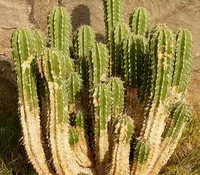
Euphorbia officinarum
Euphorbia officinarum
leatherleaf spiderwort
Tradescantia crassifolia
 POPULAR
African Milk Tree
Euphorbia trigona
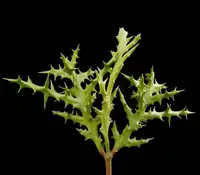
Silver thicket
Euphorbia stenoclada
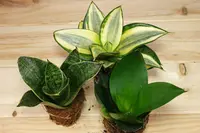
Bird's Nest Snake Plant
Dracaena trifasciata 'Hahnii'
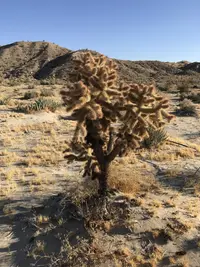
Hoffmann's teddybear cholla
Cylindropuntia fosbergii
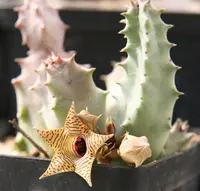
Huernia thuretii
Huernia thuretii
Baby Toes
Fenestraria rhopalophylla