


Container selection
Use a wide, heavy, shallow pot with large drainage holes so the top-heavy, branching plant stays stable and does not tip over as it matures.

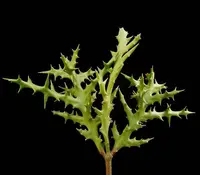
Silver thicket (Euphorbia stenoclada) is a spiny succulent shrub or small tree, valued for its dramatic, blue-gray, leafless branches. It naturally occurs in dry coastal and arid regions of Madagascar, where it has adapted to intense sun and very limited rainfall.
The plant forms a rigid, architectural thicket of jointed stems armored with sharp paired spines. Its drought tolerance and slow growth make it relatively undemanding once established, but the spines and milky sap require careful handling.
It is best suited to bright, dry conditions with fast-draining, mineral-rich soil, making it popular in xeric and succulent collections. Understanding how to care for Silver thicket mainly involves managing light, drainage, and safe handling of the plant’s sap.

Care Difficulty
Moderate Care

Light Preference
Full Sun

Water Requirements
Low Water

Temperature Preference
Tropical / Frost Sensitive

Hardiness Zone
10–11

Soil Texture
Sandy, Loamy, Rocky

Soil pH
Slightly acidic (6.5–7.0), Neutral (7.0)

Soil Drainage
Well-drained

Fertilization
Minimal (feed rarely)
Scan your plant to receive care tips personalized for your specific plant
Available on iOS and Android
This drought-adapted succulent thrives in strong light and needs long hours of sun to stay compact and healthy.
This species stores water in its stems and prefers infrequent, deep watering rather than frequent light drinks.
This arid-climate succulent favors warm, stable temperatures and must be protected from frost.
Humidity is rarely a concern for this drought-adapted species in typical indoor conditions.
This species needs a very fast-draining, mineral-rich mix that mimics arid, rocky habitats.
This species is well suited to container growing when drainage and stability are carefully managed.
This drought-adapted succulent needs only light feeding to maintain healthy growth in containers.
Pruning keeps Euphorbia stenoclada compact, safe, and structurally sound in cultivation.
Container-grown plants benefit from infrequent but careful repotting to maintain root health.
This species is usually propagated from cuttings but can also be raised from seed with patience.
This succulent is frost sensitive and needs thoughtful winter care in most temperate climates.

Plant Health Check
Not sure what's wrong with your plant? Check your plant's health inside the app.
This species is native to dry coastal regions of southwestern Madagascar, where it forms part of spiny thicket vegetation on rocky, limestone-rich soils exposed to intense sun and wind.
Mature plants are essentially leafless and perform most photosynthesis through their jointed, gray-green stems and rigid spines, an adaptation that reduces water loss in an arid climate.
Like many Euphorbia species, it produces a white latex sap that is toxic and irritating to skin and eyes, functioning as a chemical defense against herbivores.

In its native spiny thicket habitat in Madagascar, this species grows so densely and bears such rigid, interlocking branches that it can form nearly impenetrable natural barriers, providing shelter and protection for small animals in an otherwise harsh, exposed environment.
Brown tips or patches usually result from irregular watering, cold drafts, or fertilizer burn. Check roots for rot, adjust watering, and keep it away from heaters or air conditioning. Remove worst-affected stems to reduce stress.
Keep your plants happy and healthy with plant identification, disease detection, and easy care guidance.

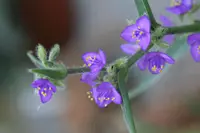
leatherleaf spiderwort
Tradescantia crassifolia
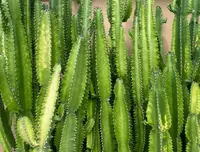 POPULAR
African Milk Tree
Euphorbia trigona
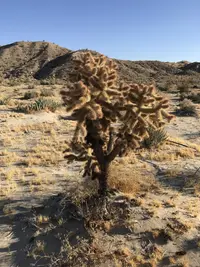
Hoffmann's teddybear cholla
Cylindropuntia fosbergii
Giant Chin Cactus
Gymnocalycium saglionis
Devil's Tongue Barrel Cactus
Ferocactus latispinus
Huernia thuretii
Huernia thuretii
Euphorbia officinarum
Euphorbia officinarum
jumping cholla
Cylindropuntia fulgida