


Seasonal rest period
Mark the plant’s summer dormancy on a calendar and sharply reduce water and handling during the hottest, brightest months to avoid breaking its natural growth cycle and stressing the roots.

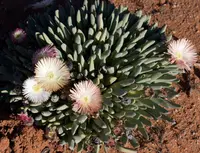
Tooth clockfig (Cheiridopsis denticulata) is a compact succulent from arid regions of South Africa. It forms small clumps of thick, paired leaves with tooth-like edges. In season, it produces daisy-like yellow flowers that open in bright light and add a striking contrast to the gray-green foliage.
This species is adapted to strong sun, poor, gritty soil, and very dry conditions for much of the year. It suits careful indoor succulent collections where the grower can control watering and light. Understanding how to care for Tooth Clockfig mainly involves respecting its natural dry-rest cycle and avoiding excess moisture.

Care Difficulty
Moderate Care

Light Preference
Full Sun

Water Requirements
Low Water

Temperature Preference
Tropical / Frost Sensitive

Hardiness Zone
10–11

Soil Texture
Sandy, Rocky, Loamy

Soil pH
Slightly acidic (6.5–7.0), Neutral (7.0)

Soil Drainage
Well-drained

Fertilization
Minimal (feed rarely)
Scan your plant to receive care tips personalized for your specific plant
Available on iOS and Android
This compact South African succulent needs bright, mostly direct sun to stay compact and colorful.
This drought-adapted succulent stores water in its leaves and is easily damaged by excess moisture.
This species prefers mild, dry conditions and is sensitive to hard frost and extreme humidity.
This desert succulent prefers very dry air and rarely suffers from low indoor humidity.
This species needs a very fast-draining, mineral-rich substrate to prevent root rot.
This compact succulent is well suited to container growing.
This compact succulent needs very light feeding, as it is adapted to nutrient-poor, sandy soils.
Cheiridopsis denticulata needs minimal pruning, mainly to maintain a compact, clean clump.
This slow-growing succulent prefers infrequent disturbance and benefits from careful, occasional repotting.
Cheiridopsis denticulata is commonly propagated by seed and, less often, by careful division of clumps.
This species prefers cool, bright, relatively dry winter conditions and has low frost tolerance.

Plant Health Check
Not sure what's wrong with your plant? Check your plant's health inside the app.
This species naturally produces one flush of thick, paired leaves each year, then lets the older pair dry into a protective papery sheath around the new growth, an adaptation to its arid winter-rainfall habitat in South Africa.
In its native Namaqualand and Richtersveld regions, it is primarily active in the cool, moist winter months and goes nearly dormant in the hot, dry summer, matching the local winter-rainfall climate rather than the typical summer-growing pattern of many succulents.
The small, tooth-like projections along the leaf edges give rise to the common name tooth clockfig and likely help break up airflow and light on the leaf surface, slightly reducing heat load and water loss in intense sun.
Brown, shriveled leaves usually result from prolonged underwatering, intense heat, or sun scorch on newly exposed leaf pairs. Old outer leaves naturally dry and die as new pairs emerge, which is normal and not a disease.
Keep your plants happy and healthy with plant identification, disease detection, and easy care guidance.


Pacific stonecrop
Sedum divergens
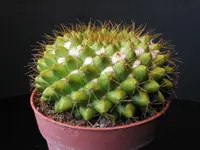
Mammillaria marksiana
Mammillaria marksiana
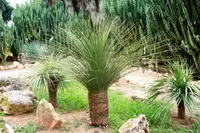
sandpaper sotol
Dasylirion serratifolium

jumping cholla
Cylindropuntia fulgida

Monadenium ritchiei
Euphorbia ritchiei
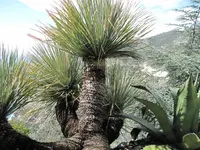
Great Desert Spoon
Dasylirion acrotrichum
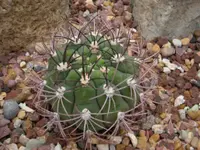
Giant Chin Cactus
Gymnocalycium saglionis
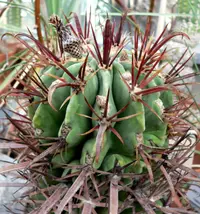
Devil's Tongue Barrel Cactus
Ferocactus latispinus