Rotate For Symmetry
Turn the pot 90° every 2–3 weeks during active growth so the body stays evenly rounded and does not lean toward the strongest light source.

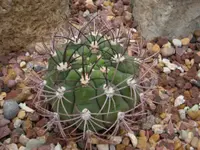
Giant chin cactus (Gymnocalycium saglionis) is a slow-growing desert cactus known for its heavy ribs, strong curved spines, and large, funnel-shaped flowers. It usually stays globular for many years before gradually forming a broad, squat mound.
This species comes from dry, rocky areas of northern Argentina, where it is adapted to intense sun, low rainfall, and mineral-rich soils. Its slow growth and strong drought tolerance make it well suited to container culture and long-term indoor display.
Once its basic needs are understood, it is relatively straightforward to care for Giant Chin Cactus. It prefers bright light, infrequent watering, and very well-drained, gritty soil to avoid root problems.

Care Difficulty
Easy Care

Light Preference
Partial Sun

Water Requirements
Low Water

Temperature Preference
Tropical / Frost Sensitive

Hardiness Zone
10–11

Soil Texture
Sandy, Loamy, Rocky

Soil pH
Acidic (5.5–6.5), Slightly acidic (6.5–7.0)

Soil Drainage
Well-drained

Fertilization
Minimal (feed rarely)
Scan your plant to receive care tips personalized for your specific plant
Available on iOS and Android
This cactus prefers bright, indirect light with some direct sun while avoiding intense midday exposure.
Watering for this cactus focuses on thorough soaking followed by a complete drying period.
This species prefers warm, dry conditions and does not tolerate frost.
This cactus prefers dry household air and does not need extra humidity.
Use a coarse, very fast-draining mineral-based mix for Gymnocalycium saglionis.
This species is well suited to container growing.
This slow-growing cactus benefits from light feeding during active growth but is sensitive to excess nutrients.
Pruning needs are minimal and focus on hygiene rather than shaping the cactus body.
Repotting Gymnocalycium saglionis is infrequent but important to prevent root congestion and exhausted soil.
Propagation is usually done from seed, as this cactus rarely produces offsets in typical home conditions.
Winter care focuses on cool, dry conditions and protection from freezing temperatures.

Plant Health Check
Not sure what's wrong with your plant? Check your plant's health inside the app.
This species forms a large, mostly solitary globe-shaped stem that can exceed 30 cm in diameter and becomes slightly flattened with age, which is unusually massive for a Gymnocalycium species.
Its ribs are wide, rounded, and deeply notched, giving the plant a strongly sculpted appearance that helps channel rare rainfall toward the root zone in its arid native habitats in northwestern Argentina.
In habitat, individual plants can persist for many decades and grow very slowly, an adaptation to the harsh, dry conditions and poor, rocky soils of its natural range.

This cactus often grows partially buried in its native environment, with only the upper part of the stem exposed; this growth habit reduces water loss, protects tissue from extreme temperature swings, and makes mature plants in the wild appear like low, armored stones on the landscape.
Growth is slow. Seedlings stay small for several years, and a plant may take 10–20 years to reach a large, barrel-like size. Limited root mass and arid adaptations naturally restrict yearly size increase.
Keep your plants happy and healthy with plant identification, disease detection, and easy care guidance.

-1-200x200.webp)