Deep root establishment
In the first 2–3 years, keep the plant in a slightly larger, deep container or planting hole to encourage a strong taproot, which greatly improves long-term drought tolerance and wind stability.

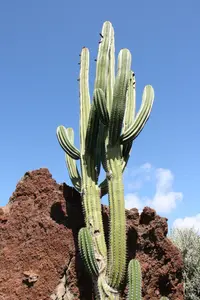
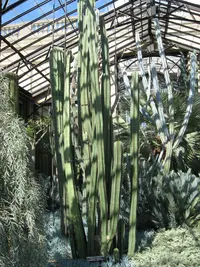
Indian comb, Pachycereus pecten-aboriginum, is a tall, columnar cactus native to arid and semi-arid regions of Mexico. In habitat it often forms imposing, tree-like clumps. Its thick, bluish-green stems carry strong ribs lined with stiff spines, and mature plants can branch to create a candelabra shape. Showy white flowers and large, spiny fruits appear on older specimens. This species is adapted to intense sun, heat, and long dry periods, which makes it relatively low-maintenance in cultivation. Those conditions also mean it resents excess moisture and poorly drained soil. For most home growers, it is straightforward to care for Indian Comb when given strong light, warmth, and a gritty, fast-draining mix.

Care Difficulty
Easy Care

Light Preference
Full Sun

Water Requirements
Low Water

Temperature Preference
Tropical / Frost Sensitive

Hardiness Zone
10–11

Soil Texture
Sandy, Loamy, Rocky

Soil pH
Slightly acidic (6.5–7.0), Neutral (7.0)

Soil Drainage
Well-drained

Fertilization
Minimal (feed rarely)
Scan your plant to receive care tips personalized for your specific plant
Available on iOS and Android
Pachycereus pecten-aboriginum thrives in strong, direct sun similar to its native desert habitats.
Pachycereus pecten-aboriginum is highly drought-tolerant and prefers infrequent, deep watering.
This tall desert cactus prefers warm, dry conditions and does not tolerate frost.
This desert cactus thrives in very dry air and rarely needs extra humidity.
This species needs a very fast-draining, mineral-heavy mix to prevent root and stem rot.
This tall, slow-growing cactus can be grown in containers if the pot is stable and drains rapidly.
This desert cactus needs only light feeding, as it is adapted to very lean soils, so caring for Indian Comb focuses on restraint.
Pachycereus pecten-aboriginum needs minimal pruning, mainly for safety and plant health rather than shaping.
This large cactus is usually grown in-ground, so transplanting is rare and should be planned carefully.
Propagation of this species is possible but slow, most often done from seeds rather than large stem cuttings.
This cactus is sensitive to prolonged freezing and needs thoughtful winter care in cooler climates.

Plant Health Check
Not sure what's wrong with your plant? Check your plant's health inside the app.
The dried, fibrous internal skeleton of the old flower stalks has long been used by Indigenous peoples of northwestern Mexico as a hair comb and brush, which is the origin of the common name Indian comb.
This cactus forms tall, branching columns that can reach tree-like dimensions and develop a stout, woody trunk, making it one of the architecturally dominant plants in parts of the Sonoran and adjacent dry forests.
Its large, fleshy fruits provide important seasonal food for local wildlife and for Indigenous communities, and the flowering and fruiting period helps support pollinators and fruit-eating animals during otherwise scarce times in its native dry habitats.

This species often hosts dense clusters of the hemiparasitic mistletoe Psittacanthus, creating striking yellow-orange masses on its green columns and forming a specialized microhabitat that attracts birds feeding on mistletoe nectar and fruits.
Growth is slow to moderate. Seedlings stay small for several years, then may add 5–15 cm per year in warm, arid climates. Cooler temperatures, limited sun, or poor drainage reduce growth rate significantly.
Keep your plants happy and healthy with plant identification, disease detection, and easy care guidance.