

Rotate container regularly
Turn the pot 90° every 2–3 weeks so the cushion develops evenly and individual heads do not stretch or lean toward the light source.

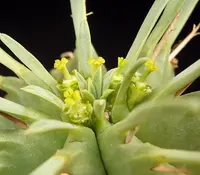
Pincushion barrelwort (Euphorbia pulvinata) is a compact, cushion-forming succulent from arid regions of South Africa. It grows as low, rounded mounds densely packed with short, angular stems. Small leaves appear briefly, while the plant relies mostly on its thick, water-storing tissue. In season, it produces tiny yellow-green flowers typical of many Euphorbia species. Euphorbia pulvinata stays relatively small, which makes it suitable for containers and windowsills. Its slow growth and drought tolerance make it appealing, but it dislikes overwatering and poorly drained soil. Bright light, infrequent watering, and a gritty, fast-draining mix are central to how to care for Pincushion Barrelwort.

Care Difficulty
Moderate Care

Light Preference
Full Sun

Water Requirements
Low Water

Temperature Preference
Tropical / Frost Sensitive

Hardiness Zone
10–11

Soil Texture
Sandy, Loamy, Rocky

Soil pH
Slightly acidic (6.5–7.0), Neutral (7.0)

Soil Drainage
Well-drained

Fertilization
Minimal (feed rarely)
Scan your plant to receive care tips personalized for your specific plant
Available on iOS and Android
This compact succulent prefers bright, dry conditions similar to high-sun arid habitats.
This species stores water in its cushion-like stems and needs infrequent but thorough watering.
This arid-adapted plant prefers warm, dry air and is sensitive to prolonged cold and frost.
This succulent prefers dry air and usually does best at 30–50% humidity.
This species needs a very fast-draining, mineral-rich, sandy substrate to avoid root rot.
This species is very suitable for container growing when drainage and stability are managed carefully.
This compact succulent needs only light feeding, as it is adapted to lean, sandy soils.
Pruning Euphorbia pulvinata is minimal and mainly for health and safety.
This species prefers to stay slightly root-bound and is repotted infrequently to limit stress.
Propagation is most successful from offsets and stem cuttings taken during warm, active growth.
This succulent is not frost hardy and needs careful winter management, especially in cold climates.

Plant Health Check
Not sure what's wrong with your plant? Check your plant's health inside the app.
This species naturally forms low, dense cushions made of many tightly packed heads, an adaptation that helps reduce water loss in its arid South African habitat.
Its short, stiff white spines reflect sunlight and create a small layer of still air around each head, offering protection from intense solar radiation and rapid temperature changes.
In cultivation it often follows the rainfall pattern of its native range, growing mainly in the cooler, brighter months and resting in the hottest part of summer if conditions are very dry.
This species generally performs better outdoors in bright, dry conditions with excellent drainage and good air movement. Indoors it often stretches and loses shape unless given very strong light, low humidity, and a gritty, fast-draining substrate.
Keep your plants happy and healthy with plant identification, disease detection, and easy care guidance.

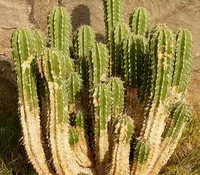
Euphorbia officinarum
Euphorbia officinarum
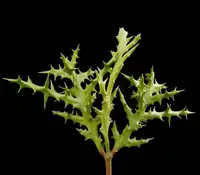
Silver thicket
Euphorbia stenoclada
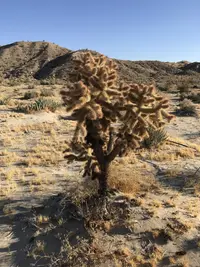
Hoffmann's teddybear cholla
Cylindropuntia fosbergii
 POPULAR
African Milk Tree
Euphorbia trigona
Bird's Nest Snake Plant
Dracaena trifasciata 'Hahnii'
Huernia thuretii
Huernia thuretii
royal dewflower
Drosanthemum speciosum
Baby Toes
Fenestraria rhopalophylla