Branch training
Gently bend and tie young stems to a small hoop or wire frame to encourage an even, spiraled form and prevent the brittle branches from snapping as they elongate.

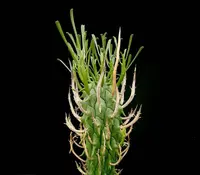
Compass Barrelwort (Euphorbia schoenlandii) is a succulent shrub-like euphorbia with segmented, often zigzagging green stems and sparse, small leaves. It develops a sculptural, architectural form that suits containers and bright indoor spots.
This species is native to arid regions of southern Africa, where it has adapted to strong light, rapid drainage, and dry periods. Its drought tolerance and slow, compact growth make it relatively easy to manage, as long as excess moisture is avoided.
Those who want to learn how to care for Compass Barrelwort should focus on bright light, very free-draining soil, and infrequent but thorough watering, allowing the plant to dry between waterings.

Care Difficulty
Moderate Care

Light Preference
Full Sun

Water Requirements
Low Water

Temperature Preference
Tropical / Frost Sensitive

Hardiness Zone
10–11

Soil Texture
Sandy, Loamy, Rocky

Soil pH
Slightly acidic (6.5–7.0), Neutral (7.0)

Soil Drainage
Well-drained

Fertilization
Minimal (feed rarely)
Scan your plant to receive care tips personalized for your specific plant
Available on iOS and Android
This drought-tolerant succulent prefers bright, indirect light with some direct sun for compact growth.
This plant stores water in its stems and needs infrequent but thorough watering in fast-draining soil.
This species prefers warm, dry conditions and does not tolerate prolonged cold or frost.
This drought-adapted succulent tolerates 30–50% humidity and usually does not need extra moisture in the air.
Use a very fast-draining, mineral-based mix to prevent root and stem rot.
This species is very suitable for container growing due to its compact, succulent root system.
This drought-tolerant succulent needs modest feeding to support steady, compact growth without forcing soft, weak tissue in Euphorbia schoenlandii.
Pruning helps maintain a tidy, stable shape and removes damaged tissue on Euphorbia schoenlandii without stressing the plant.
This species prefers a stable root environment and benefits from infrequent, careful repotting in a free-draining mix.
New plants are most often produced from stem cuttings, as seed of Euphorbia schoenlandii can be scarce and variable.
This succulent is sensitive to hard frost and benefits from controlled, dry conditions during winter dormancy, especially in colder regions.

Plant Health Check
Not sure what's wrong with your plant? Check your plant's health inside the app.
This species forms a semi-woody, much-branched succulent shrub with angled, green stems that store water, an adaptation to the seasonally dry habitats of southern Africa where it is native.
Like other spurges, it produces cyathia, which are specialized cup-shaped inflorescences rather than true single flowers, often surrounded by small bracts that attract pollinators despite the very reduced floral parts.
The plant exudes a white, sticky latex when cut or damaged; this toxic sap helps deter herbivores and protects wounds from microbial attack but can irritate human skin and eyes.
Growth slows when light is too low, temperatures are cool, or the pot is tight. Old, exhausted soil and infrequent feeding also reduce vigor. After correcting these factors, new growth may still take several weeks to respond.
Keep your plants happy and healthy with plant identification, disease detection, and easy care guidance.