Toxic sap handling
Always wear nitrile gloves and eye protection when pruning or repotting, and keep paper towels and running water nearby so any milky sap on skin or tools can be wiped off and rinsed immediately.

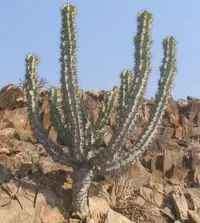
Euphorbia virosa, commonly called Namib candelabra naboom, is a sculptural, spiny succulent shrub that resembles a many-armed cactus. It stores water in thick, ridged stems and has no showy leaves.
This species is native to the hot, arid regions of Namibia and Angola, where it grows on rocky slopes and desert plains. It is adapted to intense sun, high temperatures, and very limited rainfall.
Its drought tolerance and slow growth rate make it fairly low-maintenance, but its toxic, milky sap and sharp spines require careful handling. It prefers strong light, very well-drained mineral soil, and minimal watering, so learning how to care for Namib Candelabra Naboom is mainly about avoiding excess moisture and physical damage.

Care Difficulty
Moderate Care

Light Preference
Full Sun

Water Requirements
Low Water

Temperature Preference
Tropical / Frost Sensitive

Hardiness Zone
10–12

Soil Texture
Sandy, Rocky, Loamy

Soil pH
Slightly acidic (6.5–7.0), Neutral (7.0)

Soil Drainage
Well-drained

Fertilization
Minimal (feed rarely)
Scan your plant to receive care tips personalized for your specific plant
Available on iOS and Android
This desert succulent thrives in intense light but still needs protection from extreme exposure in cultivation.
This species is highly drought-adapted and needs far less water than most ornamentals.
This plant is adapted to hot, arid conditions and does best with warm, stable temperatures.
This arid Euphorbia prefers very dry air and usually does not need extra humidity.
This succulent needs very sharply drained, mineral soil to prevent root rot.
This species is well suited to container culture due to its slow growth and preference for controlled drainage.
Euphorbia virosa is adapted to very poor soils and usually needs only light, infrequent feeding in cultivation.
Pruning Euphorbia virosa is mainly corrective and for safety, rather than to encourage vigorous new growth.
Container-grown Euphorbia virosa or young nursery plants benefit from infrequent, careful repotting to avoid root disturbance.
Propagation of Euphorbia virosa is possible but slow and best attempted by experienced growers who understand its toxic sap.
Euphorbia virosa is not frost hardy and needs careful winter management in most temperate climates.

Plant Health Check
Not sure what's wrong with your plant? Check your plant's health inside the app.
The milky sap of this species contains potent diterpenoid esters that can cause severe skin irritation and eye damage, and is considered among the more dangerous latexes in the genus Euphorbia.
In its native Namib Desert range, this plant survives on extremely low rainfall and can benefit from coastal fog, using its succulent, ribbed stems to store water between rare precipitation events.
Mature plants often develop several thick, erect, many-ribbed branches from a short trunk, forming a rigid candelabra shape that helps minimize direct sun exposure on any single stem surface.

Local reports from parts of Namibia and South Africa describe this species being historically used to prepare arrow poisons, reflecting the recognized potency of its latex among indigenous communities.
This species performs best outdoors in hot, arid climates with maximum sun and airflow. It can survive indoors only in very bright, dry conditions near a sunny window, but growth is slower and stems may elongate weakly.
Keep your plants happy and healthy with plant identification, disease detection, and easy care guidance.