Control Carpet Spread
Lift and thin congested patches every 2–3 years by gently tearing or cutting small clumps and replanting them 10–15 cm apart to maintain airflow and prevent dieback in the crowded center.

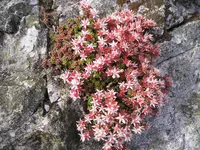
English stonecrop (Sedum anglicum) is a small, mat-forming succulent that creates dense carpets of fleshy, rounded leaves. It often shows red or pink tints in strong light and produces small star-shaped white to pale pink flowers in clusters. This species is native to rocky coasts and uplands of western Europe, where it grows in thin, well-drained soils. Its natural adaptation to harsh, dry conditions makes it a durable and low-maintenance choice for rock gardens, green roofs, and groundcover. It tolerates drought, poor soils, and full sun, which simplifies how to care for English Stonecrop in many home landscapes.

Care Difficulty
Easy Care

Light Preference
Full Sun

Water Requirements
Low Water

Temperature Preference
Cold Hardy

Hardiness Zone
5–9

Soil Texture
Sandy, Loamy, Rocky

Soil pH
Slightly acidic (6.5–7.0), Neutral (7.0)

Soil Drainage
Well-drained

Fertilization
Minimal (feed rarely)
Scan your plant to receive care tips personalized for your specific plant
Available on iOS and Android
This low-growing succulent thrives in bright conditions with direct sun for compact, colorful growth.
This species prefers infrequent, light watering and dries quickly in its shallow root zone.
This hardy groundcover tolerates a wide temperature range but grows best in mild conditions.
This species handles 30–50% humidity and usually does not need special humidity management.
Sedum anglicum prefers very free-draining, mineral-rich soil that dries quickly between waterings.
This species is well suited to container growing, especially shallow pots and troughs.
Sedum anglicum thrives in low-nutrient soils and usually needs only light feeding in containers or very poor ground.
Sedum anglicum responds well to light, targeted pruning that keeps mats dense and tidy.
This low-growing sedum is usually transplanted outdoors rather than repotted often in containers.
Sedum anglicum is commonly multiplied by stem cuttings and division, with seeds as a slower option.
This species is generally cold hardy and needs minimal winter care in the ground in most temperate regions.

Plant Health Check
Not sure what's wrong with your plant? Check your plant's health inside the app.
This species is naturally confined to oceanic western Europe, where it forms dense mats in thin, gravelly soils on sea cliffs, rocky outcrops, and coastal walls, tolerating salt spray better than many other small sedums.
Its leaves are very small, cylindrical to slightly club-shaped, and store water efficiently, which allows the plant to survive repeated drying in exposed, windy sites close to the sea.
The star-shaped white flowers often flush pink in strong light and typically appear in early to mid-summer, providing nectar for small pollinating insects in harsh coastal environments.

Sedum anglicum is one of the characteristic species of UK and Irish maritime rock and wall plant communities, and botanists often use its presence as an indicator of long-established, relatively undisturbed coastal habitats.
This species spreads slowly to moderately by short creeping stems and self-seeding. It forms low mats but usually stays well-behaved in gardens. Containment is simple: edge or lift unwanted sections and thin seedlings if they appear in gravel or cracks.
Keep your plants happy and healthy with plant identification, disease detection, and easy care guidance.