Winter crown protection
In colder zones, pile 5–10 cm of coarse mulch or pine needles around, but not over, the crown in late fall to buffer freeze–thaw cycles and reduce the risk of winter heaving that can loosen roots.

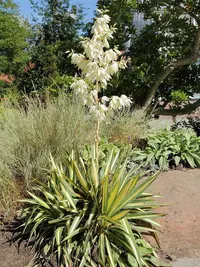
Adam's needle (Yucca filamentosa 'Color Guard') is an evergreen perennial shrub from the southeastern United States, often used in dry gardens and architectural plantings. It forms a clumping rosette of stiff, sword-like leaves.
This cultivar is known for its yellow-centered leaves edged in green, sometimes with pink tones in cold weather, and tall summer flower spikes with white, bell-shaped blooms. Its tough leaves and deep root system make it drought-tolerant and long-lived in the landscape.
It prefers full sun, very well-drained soil, and low to moderate moisture, which helps explain how to care for Adam's Needle in most home gardens.

Care Difficulty
Easy Care

Light Preference
Full Sun

Water Requirements
Low Water

Temperature Preference
Cold Hardy

Hardiness Zone
4–10

Soil Texture
Sandy, Loamy, Rocky

Soil pH
Slightly acidic (6.5–7.0), Slightly alkaline (7.0–7.5)

Soil Drainage
Well-drained

Fertilization
Minimal (feed rarely)
Scan your plant to receive care tips personalized for your specific plant
Available on iOS and Android
Yucca filamentosa 'Color Guard' develops its strongest variegation in bright, direct sun outdoors.
This drought-tolerant yucca prefers thorough but infrequent watering in sharply drained soil.
This hardy yucca tolerates a wide temperature range but grows best in moderate warmth.
Humidity is rarely a concern for Yucca filamentosa 'Color Guard' grown in typical indoor or outdoor conditions.
Yucca filamentosa 'Color Guard' prefers lean, well-drained, mineral soils that never stay waterlogged.
This species is well-suited to container growing for patios, entries, or dry garden displays.
Yucca filamentosa 'Color Guard' is low maintenance and only needs light feeding in lean soils, making caring for Adam's Needle straightforward.
Yucca filamentosa 'Color Guard' benefits from periodic cleanup pruning to maintain a tidy rosette and consistent flowering.
This yucca is usually grown in the ground; transplant or move containers only when crowding or poor performance appears.
Yucca filamentosa 'Color Guard' is most commonly propagated by division of offsets rather than from seed.
This yucca is cold hardy in much of the US and usually needs minimal winter care outdoors.

Plant Health Check
Not sure what's wrong with your plant? Check your plant's health inside the app.
This cultivar keeps its yellow-centered leaves reliably through the seasons because the variegation is genetically fixed, unlike many variegated plants that often revert to plain green forms over time.
Although it has a tropical, succulent look, this plant survives typical winters in much of the US because its rosette growth habit protects the crown and its tissues tolerate repeated freeze–thaw cycles.
Mature plants can send up tall, branched inflorescences covered in creamy white, bell-shaped flowers, creating a strong vertical accent that contrasts with the stiff, sword-like foliage below.

Yucca filamentosa 'Color Guard' arose as a horticultural selection from the naturally occurring Adam's needle, meaning it does not exist as a wild population but is maintained entirely through cultivation and vegetative propagation.
Flowering usually starts on mature plants, often after several years. Lack of blooms is commonly due to insufficient age, poor drainage, or heavy fertilizer use. Avoid high-nitrogen feeding and ensure the plant is not shaded by taller vegetation.
Keep your plants happy and healthy with plant identification, disease detection, and easy care guidance.