Early staking system
Install sturdy stakes or a low wire ring around young shoots in spring so the tall stems grow through the support and stay upright in wind and heavy rain.

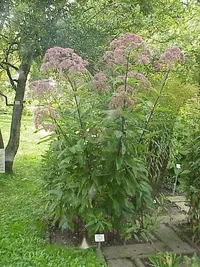
Purple Joe-Pye weed, Eutrochium purpureum, is a tall, clump-forming perennial native to moist meadows and woodland edges in eastern North America. It is commonly grown in naturalistic borders, rain gardens, and pollinator plantings.
The plant forms upright stems topped with domed clusters of soft purple to pink flower heads in late summer. These nectar-rich blooms strongly attract butterflies, bees, and other beneficial insects.
Its size and deep root system make it best suited to larger beds or informal landscapes rather than small containers. Gardeners who learn how to care for purple Joe-Pye weed usually find it long-lived and reliable.
It prefers full sun to light shade, consistently moist soil, and benefits from sites with good organic content and adequate space for its mature height and spread.

Care Difficulty
Easy Care

Light Preference
Partial Sun

Water Requirements
Regular Water

Temperature Preference
Cold Hardy

Hardiness Zone
4–9

Soil Texture
Loamy, Clay, Organic-rich

Soil pH
Acidic (5.5–6.5), Slightly acidic (6.5–7.0)

Soil Drainage
Moist but well-drained

Fertilization
Minimal (feed rarely)
Scan your plant to receive care tips personalized for your specific plant
Available on iOS and Android
This tall native perennial prefers consistent light but is adaptable across many garden conditions.
This species prefers evenly moist soil and does not tolerate prolonged drying.
This hardy perennial is adapted to temperate climates with cold winters and warm summers.
This moisture-loving perennial prefers consistently moist air but usually adapts to typical outdoor humidity.
This species grows best in deep, moisture-retentive but aerated soil with a high organic content.
This tall species can be grown in containers, but only in large, stable pots outdoors.
This hardy native needs only modest feeding to support strong growth and flowering.
Thoughtful pruning keeps Eutrochium purpureum upright, tidy, and flowering well.
This tall perennial is usually grown in the ground, so transplanting clumps is more common than container repotting.
Propagation is typically done by division or seed, both suited to a perennial like this.
This species is cold hardy in much of North America and normally needs minimal winter care.

Plant Health Check
Not sure what's wrong with your plant? Check your plant's health inside the app.
Purple Joe-Pye weed is a major late-summer nectar source for monarch butterflies during their southward migration, often attracting dense clusters of adults to a single patch.
In the wild, this species is most common along woodland edges, stream banks, and moist meadows in eastern North America, where its deep root system tolerates periodic flooding yet also survives short dry spells.
Mature plants can reach 150–240 cm with branching, candelabra-like stems topped by flat-topped clusters of mauve-pink florets that provide a long flowering season from mid to late summer.

This species synthesizes complex aromatic compounds in its leaves and stems that give off a faint vanilla-like scent when crushed, which helps distinguish it from closely related Joe-Pye weed species that lack this characteristic fragrance.
This species is highly attractive to butterflies, bees, and other pollinators due to its large, nectar-rich flower clusters. It works well in pollinator gardens and can significantly increase late-summer insect activity in the area.
Keep your plants happy and healthy with plant identification, disease detection, and easy care guidance.