Winter rest period
Reduce watering to very light, infrequent sips in winter and keep the plant slightly cooler to allow a semi-dormant rest period that promotes compact growth and better flowering the following season.

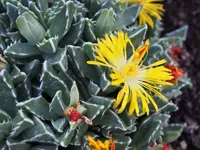
Camdeboo tigerfig (Faucaria bosscheana) is a small, clumping succulent from arid regions of South Africa. It forms low rosettes of thick, triangular leaves with distinctive tooth-like edges.
The leaves are usually grey-green with mottled markings, giving the plant a textured, compact look. In good light it produces bright, daisy-like yellow flowers in late season.
This species is adapted to strong sun, sharp drainage, and dry spells, which makes it sensitive to overwatering but well suited to containers and windowsills. With an understanding of how to care for Camdeboo Tigerfig, most growers find it manageable as a long-lived indoor succulent.

Care Difficulty
Easy Care

Light Preference
Full Sun

Water Requirements
Low Water

Temperature Preference
Warm Climate

Hardiness Zone
9–11

Soil Texture
Sandy, Loamy, Rocky

Soil pH
Slightly acidic (6.5–7.0), Neutral (7.0)

Soil Drainage
Well-drained

Fertilization
Minimal (feed rarely)
Scan your plant to receive care tips personalized for your specific plant
Available on iOS and Android
This compact succulent prefers bright, direct light but needs protection from extreme midday sun in hot climates.
This drought-adapted succulent needs infrequent, careful watering and very fast-draining soil.
This species prefers warm, dry conditions and is sensitive to prolonged cold and frost.
This succulent handles low humidity well and rarely needs special moisture control indoors.
This species needs a very fast-draining, mineral-based mix to prevent root rot.
This compact succulent grows very well in containers when drainage is carefully managed.
This compact succulent benefits from light feeding but Camdeboo Tigerfig is sensitive to excess nutrients.
Faucaria bosscheana needs only minimal pruning to maintain a tidy, healthy clump.
This small succulent prefers tight quarters and infrequent repotting in well-drained media.
Faucaria bosscheana is commonly propagated from offsets and sometimes from seed under warm, bright conditions.
This succulent is not frost hardy and needs specific winter care in most climates.

Plant Health Check
Not sure what's wrong with your plant? Check your plant's health inside the app.
This species occurs naturally in a very limited area of the Camdeboo region in South Africa’s Eastern Cape, where it grows on rocky flats and low ridges with very shallow, well-drained soils.
Compared with other Faucaria species, it has relatively fewer but more robust, triangular marginal teeth on the leaf edges, which contribute to its characteristic “tiger jaw” appearance and help reduce herbivory.
In cultivation and in habitat, it typically produces its yellow, daisy-like flowers in late summer to autumn, opening in bright afternoon light and remaining closed on dull or overcast days.
Lack of flowering often results from insufficient light intensity, very frequent watering, or using high-nitrogen fertilizer. Cooler, bright conditions in autumn plus a slight dry rest period usually trigger buds and improve blooming reliability.
Keep your plants happy and healthy with plant identification, disease detection, and easy care guidance.