


Rotate For Symmetry
Turn the pot 90° every 3–4 weeks during the bright season so the stem grows evenly and does not lean toward the main light source.

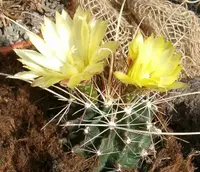
Ferocactus hamatacanthus, commonly called turk's head, is a barrel cactus native to arid regions of Texas and northern Mexico. It grows as a rounded to slightly elongated globe with strong, hooked spines and a pronounced central crown. In the right conditions, it produces showy yellow flowers near the top, followed by small, fleshy fruits. This species is adapted to intense sun, rocky or sandy soils, and long dry periods, which makes it relatively low-maintenance when overwatering is avoided. For those learning how to care for turk's head, its slow growth, drought tolerance, and clear visual signals of stress make it a straightforward cactus for patient growers.

Care Difficulty
Moderate Care

Light Preference
Full Sun

Water Requirements
Low Water

Temperature Preference
Warm Climate

Hardiness Zone
8–11

Soil Texture
Sandy, Rocky, Loamy

Soil pH
Slightly acidic (6.5–7.0), Slightly alkaline (7.0–7.5)

Soil Drainage
Well-drained

Fertilization
Minimal (feed rarely)
Scan your plant to receive care tips personalized for your specific plant
Available on iOS and Android
Ferocactus hamatacanthus thrives in strong, direct sun typical of arid habitats.
Ferocactus hamatacanthus prefers thorough but infrequent watering suited to desert cacti.
This cactus is adapted to hot, dry climates but has some tolerance for cooler conditions when kept dry.
This cactus prefers dry air and does not need extra humidity beyond typical indoor levels.
This cactus needs a very fast-draining, mineral-based substrate to prevent root rot.
This species is well suited to container culture when planted in a stable, well-drained pot.
This cactus benefits from light feeding but remains adapted to nutrient-poor soils, so avoid heavy fertilization when caring for turk's head.
Ferocactus hamatacanthus needs almost no structural pruning and is usually maintained by simple cleaning.
This barrel cactus prefers to stay undisturbed, but occasional repotting or transplanting keeps roots healthy in containers or rock gardens.
This species is most often propagated from seed, as it rarely offsets and cutting propagation is limited.
Mature plants handle brief light frost if kept dry, but careful winter management improves long-term health.

Plant Health Check
Not sure what's wrong with your plant? Check your plant's health inside the app.
This species develops strongly hooked central spines that can catch debris and provide shade, helping protect the stem from intense sun and reducing water loss in its arid native habitats in Texas and northern Mexico.
Mature plants produce relatively large, bright yellow funnel-shaped flowers in a ring near the stem apex, a striking display considering the compact, heavily armored body of the cactus.
After flowering, it forms elongated, fleshy fruits that are edible and have been locally used as a minor wild food resource, although they are not widely cultivated or traded.

In habitat, this species can reach up to around 45 cm tall with a relatively narrow, cylindrical body, making it one of the more elongate barrel cacti in its genus, especially in older specimens that have grown undisturbed for many years.
Lack of flowers usually comes from insufficient light, a pot that is too small, or the plant being too young. It needs strong sun, a cool dry winter rest, and time to reach flowering size.
Keep your plants happy and healthy with plant identification, disease detection, and easy care guidance.

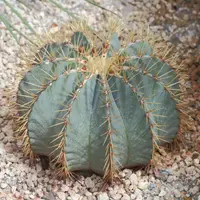
glaucous barrel cactus
Ferocactus glaucescens
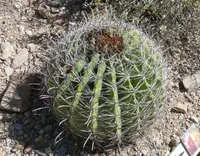
candy barrelcactus
Ferocactus wislizeni
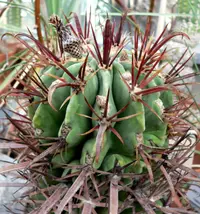
Devil's Tongue Barrel Cactus
Ferocactus latispinus
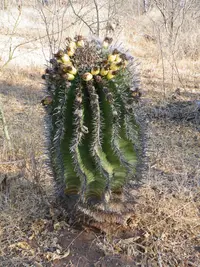
Cactus
Ferocactus herrerae
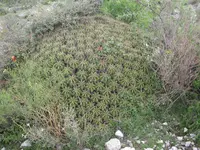
Cactus
Ferocactus robustus
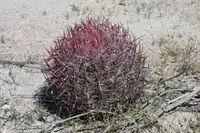
Fire Barrel Cactus
Ferocactus gracilis
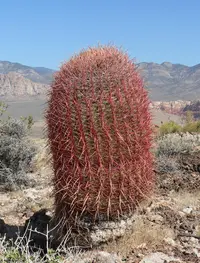
California barrel cactus
Ferocactus cylindraceus

chautle livingrock
Ariocarpus fissuratus