

wild strawberry Identification (Fragaria vesca)

To recognize wild strawberry, look for a low, runner-forming plant with leaves divided into three toothed leaflets on long stalks rising from the base. Plants usually stay under 8 inches (20 cm) tall.

Flowers are white, about 1/2 inch (1.3 cm) across, with five petals held above the leaves on separate stalks.

Fragaria vesca Identification

Identify Your Plant with Botan

Not sure about your plant ID? Upload a photo and check it with Botan.

Clear images work best. Avoid photos taken too close or too far away

Check for the low, delicate form of Fragaria vesca and its three-part leaves.

  • Leaves are divided into 3 toothed leaflets, with the middle leaflet on a short stalk.
  • Plants stay low, usually under 8 inches (20 cm) tall, in small clumps or with thin runners.
  • Flowers are white with 5 petals and a yellow center, held above the leaves.
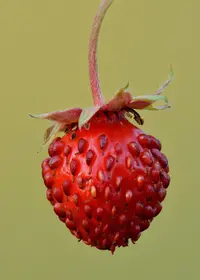
  • Fruits are small, red, and conical to egg-shaped, with many tiny seeds on the surface.

Leaflet shape, raised flowers, and small surface-seeded fruit are the quickest checks.

Fragaria vesca shows clear visual changes from early leaf stages to fruiting rosettes.

  • Seedling: First growth shows small simple seed leaves, followed by the first true leaf with three leaflets, signaling the species’ typical trifoliate pattern.
  • Young plant: A low basal rosette forms on a short crown, with longer leaf stalks and toothed leaflet edges becoming clearer as runners may begin.
  • Flowering stage: Leafless stalks rise above the foliage and carry white five-petaled flowers about 1/2 inch (1.3 cm) across, separating reproductive growth from the rosette.
  • Fruiting stage: After flowering, the plant bears small red strawberry fruits held above or just beyond the leaves, with the enlarged fleshy receptacle becoming the main visual cue.

In spring, Fragaria vesca quickly becomes easier to spot as fresh trifoliate leaves unfold and small white five-petaled flowers rise just above or among the foliage. By early summer, the flowers give way to small red strawberries, a strong field clue. In cold-winter areas, the plant may look reduced or partly bare in winter, then leaf out again in spring.

Several low, trifoliate plants can be mistaken for wild strawberry.

mock strawberry(Potentilla indica)

Often confused because it has three leaflets and strawberry-like red fruit. The flowers are yellow, not white, and the fruits usually sit upright rather than hanging down.

barren strawberry(Waldsteinia fragarioides)

Similar in its low habit and toothed three-part leaves. It differs by having yellow flowers and dry, non-berry fruits, so it lacks the fleshy red strawberry-like fruit.

wood avens(Geum urbanum)

Young plants can resemble it through trifoliate, toothed leaves. Geum usually forms a taller, looser plant with branching stems and small hooked seed heads instead of red berries.

Fragaria vesca is native across much of Europe, temperate Asia, and North America. Its wide native range matters less than its setting. It is most often found in open woodland, forest edges, clearings, banks, and grassy paths, usually in cool to temperate regions. Finding it in lightly shaded woodland margins helps separate it from some non-woodland strawberry look-alikes.

Does Your Plant Match?

Use Botan to compare a photo and confirm the plant, helping avoid mix-ups before you label it or buy another one.

FAQ

The best clue is the small red fruit with achenes, the tiny seed-like dots, sitting on the outside. In this species, ripe fruits are usually held above the leaves on slender stalks, which helps with wild strawberry identification.

More Plant Identification Guides

Identify Your Plant and Learn More

Identify a plant from a photo with Botan, then get species-specific care information, safety notes, and common problems.

Botan app identifying a plant from a photo
How to Mulch in the Fall and When to Wait Until Spring

5 min read · 12 Nov 2026

How to Mulch in the Fall and When to Wait Until Spring

In the fall, mulch gives the roots of trees and shrubs insulation and more stable conditions through winter. In the spring, it mainly suppresses weeds and keeps moisture in the soil during the growing season.

Beginner Guides
How to Mulch in the Fall and When to Wait Until Spring
20 Most Popular Fruits Around the World

7 min read · 22 Jul 2026

20 Most Popular Fruits Around the World

Curious which fruits the world actually eats the most? Here's the top-20 by production volume, an overview of what people choose in each region, and a few figures that defy common assumptions.

Plant Recommendations
20 Most Popular Fruits Around the World
What Do Plants Need to Grow – 5 Things Every Greenery Can't Live Without

8 min read · 31 Jul 2026

What Do Plants Need to Grow – 5 Things Every Greenery Can't Live Without

To keep plants healthy and thriving, provide the right balance of light, humidity, nutrients, airflow, and quality soil. This guide covers the essentials of year-round plant care.

Beginner Guides
What Do Plants Need to Grow – 5 Things Every Greenery Can't Live Without