
Nanking cherry Identification (Prunus tomentosa)

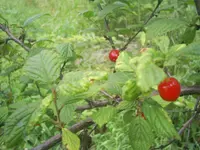
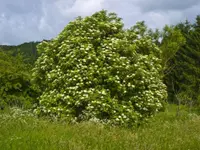
Recognize Nanking cherry by its dense, many-stemmed shrub form, usually 6 to 10 feet tall (1.8 to 3 m), with alternate oval leaves that are finely serrated and distinctly hairy.

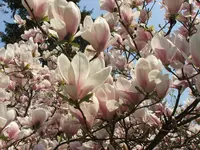
In bloom, look for pale pink to white five-petaled flowers borne singly or in pairs along short side shoots before the leaves fully expand.

Prunus tomentosa Identification

Check Your Plant ID

Not sure about your plant ID? Upload a photo and check it with Botan.

Clear images work best. Avoid photos taken too close or too far away

Check the shrub’s compact form, leaves, flowers, and fruit.

  • Usually a dense, many-stemmed shrub, often about 6-10 feet (1.8-3 m) tall and wide.
  • Leaves are alternate, oval to oblong, finely toothed, and softly hairy, often 1-3 inches (2.5-7.5 cm) long.
  • Flowers are single or paired along the twigs, with 5 pale pink to white petals.
  • Fruits are small, round drupes, typically red, about 1/4-1/2 inch (0.6-1.3 cm) across.

Hairy leaves and a dense, twiggy shrub shape are especially useful when no flowers or fruit are present.

Nanking cherry shows clear visual shifts from a small shrub to a fruiting thicket.

  • Young plant: Young plants are upright and lightly branched, with slim twigs and relatively large, oval leaves that make the framework look open rather than densely twiggy.
  • Mature plant: Mature plants form a broad, many-stemmed shrub about 6-10 feet (1.8-3 m) tall, with crowded short branchlets and a denser, rounded outline.
  • Flowering stage: Flowers appear before or with the earliest leaves, sitting close along bare twigs; the pale pink to white blossoms are paired or clustered.
  • Fruiting stage: Fruits change the shrub's look by hanging close to the stems as small round red cherries, often partly hidden by the fuzzy leaves.

In early to mid-spring, Prunus tomentosa often flowers before or as the leaves emerge. Branches can look lined with small pale pink to white blossoms, which makes the shrub stand out while much of the stem structure is still visible. By early summer, round red fruits become visible against the foliage. In fall, leaves turn yellow to orange before dropping, exposing the dense twiggy branching through winter.

These shrubs are the most realistic look-alikes for Nanking cherry.

bush cherry(Prunus japonica)

Often confused because both are small shrubs with early pink flowers and red cherries. Bush cherry usually spreads by suckers into thickets, while Prunus tomentosa is denser and more mounded. Its leaves are also less distinctly hairy underneath.

sand cherry(Prunus pumila)

Confusion happens when plants are seen in fruit. Both can carry small dark red cherries on short stems. Sand cherry is lower and more sprawling, often under 6 feet (1.8 m), with narrower leaves; Prunus tomentosa has broader, softly hairy leaves and a more upright shrub form.

Prunus tomentosa is native to northern and central China, Mongolia, and Korea. It occurs in thickets, open hillsides, valley scrub, forest margins, and disturbed ground, often in cool temperate settings. That range helps with identification because this species is associated with inland, continental habitats rather than humid coastal forests or subtropical woodland. Seeing a cherry relative naturalized around old fields or scrubby slopes can help narrow it from less cold-region Prunus species.

  • Seeds and wilted leaves: Prunus tomentosa has cyanogenic compounds in the seeds and in leaves, especially when wilted. This matters if eaten by humans or pets.
  • Fruit pit hazard: The fleshy fruit is not the main concern, but the hard pit contains the seed. Risk relates to ingestion of crushed or chewed pits by humans or pets.

Confirm the Species with Botan

Upload a photo to compare key details and get help identifying or confirming the plant before you label it.

FAQ

It is often confused with sand cherry and other bush cherries. For Nanking cherry identification, check the softly hairy leaves and twigs, pale pink to white spring flowers, and small round red cherries on short stalks.

More Plant Identification Guides

Know What Plant You Have

Identify a plant from a photo with Botan, then get species-specific care information, plant details, and common problems.

Botan app identifying a plant from a photo
Is Sugar Water Good for Plants?

4 min read · 14 Sept 2026

Is Sugar Water Good for Plants?

Sugar water may sound like an easy boost, but most rooted plants do not need extra sucrose. This guide explains how green tissues produce carbohydrates, when a sweetened solution can be useful, and why too much can cause problems.

Plant Care
Is Sugar Water Good for Plants?
How to Mulch in the Fall and When to Wait Until Spring

5 min read · 12 Nov 2026

How to Mulch in the Fall and When to Wait Until Spring

In the fall, mulch gives the roots of trees and shrubs insulation and more stable conditions through winter. In the spring, it mainly suppresses weeds and keeps moisture in the soil during the growing season.

Beginner Guides
How to Mulch in the Fall and When to Wait Until Spring
Banana Peel Water for Plants: 5 Things to Know Before Trying It

5 min read · 9 Jul 2026

Banana Peel Water for Plants: 5 Things to Know Before Trying It

Banana water can provide potassium and some nutrients that may support plant growth, but it is not a universal fix. Use it carefully and only when the plant actually shows signs of nutrient deficiency rather than as a routine treatment.

Plant Care
Banana Peel Water for Plants: 5 Things to Know Before Trying It