Nanking cherry Care (Prunus tomentosa)

Also known as: Chinese bush cherry
Nanking cherry

About Nanking cherry

Nanking cherry (Prunus tomentosa) is a compact deciduous shrub grown mainly for its early spring blossoms and small, bright red cherries. It forms a rounded, bushy shape with many fine twigs and attractive gray-brown bark.

The plant is native to northern China, Korea, and Mongolia and is well adapted to cold climates. It is valued in home gardens for its combination of ornamental flowers and edible fruit.

Nanking cherry generally prefers full sun, well-drained soil, and moderate moisture. Once established, it is relatively hardy and low-maintenance, which makes it straightforward to care for Nanking cherry in temperate regions.

Main Plant Requirements

Care Difficulty

Moderate Care

Light Preference

Full Sun

Water Requirements

Moderate Water

Temperature Preference

Cold Hardy

Hardiness Zone

3–7

Soil Texture

Sandy, Loamy, Clay

Soil pH

Acidic (5.5–6.5), Slightly acidic (6.5–7.0)

Soil Drainage

Well-drained

Fertilization

Minimal (feed rarely)

Get Personalized Care Plan

Scan your plant to receive care tips personalized for your specific plant

Available on iOS and Android

How to Care for the Nanking cherry

This shrub fruits best in full sun but accepts some light shade in hot climates.

  • Provide 6–8 hours of direct sun daily; morning sun with light afternoon shade reduces leaf scorch in hotter regions.
  • Nanking cherry tolerates partial shade (4–5 hours sun), but expect fewer flowers and reduced fruit set in these conditions.
  • Ensure the site stays unshaded by trees or buildings from late winter to spring so flower buds receive strong light for reliable blooming.

This species prefers evenly moist, well-drained soil and does not tolerate standing water.

  • Allow the top 3–5 cm of soil to dry before deep watering, ensuring moisture reaches the full root zone but drains within a few hours.
  • Increase watering during hot, dry periods and the first 1–2 growing seasons; reduce frequency in cool, rainy weather and once the shrub is established.
  • Watch for yellowing, soft leaves as a sign of overwatering and dull, curling leaves or twig dieback as indicators of underwatering in Prunus tomentosa.

This cold-hardy shrub thrives in temperate climates with distinct seasons.

  • Active growth is strongest at 60–75°F (16–24°C), with good performance in typical spring and early summer conditions.
  • Mature plants tolerate winter lows near -30°F (-34°C), but late frosts around 28–30°F (-2 to -1°C) can damage open blossoms and reduce fruit set.
  • In hot summers, shrubs handle short periods up to about 90°F (32°C) if soil moisture is maintained and roots are mulched to moderate temperature swings.

Humidity is rarely a limiting factor for Nanking cherry grown outdoors in typical US climates.

Prunus tomentosa prefers moderately fertile, well-structured mineral soil with efficient drainage.

  • Use a loamy or sandy-loam soil with 10–30% organic matter to support moisture retention without becoming waterlogged.
  • Aim for a slightly acidic to neutral pH of 6.0–7.5, adjusting with garden lime or elemental sulfur if needed.
  • In heavier soils, improve drainage and aeration by mixing in coarse sand and fine gravel rather than only peat-based amendments.
  • Avoid compacted, poorly drained, or consistently waterlogged sites that promote root rot and weak root development.

This species can be grown in containers for several years if given adequate root volume and stable conditions.

  • Choose a deep, heavy container that resists tipping as the shrub develops a bushy, fruit-laden canopy.
  • Use a fast-draining, mineral-based mix, such as garden loam blended with coarse sand and bark, to prevent perched water near the root zone.
  • Elevate the pot slightly on feet or blocks so drainage holes clear the ground and excess water escapes freely after rainfall or irrigation.

Prunus tomentosa benefits from moderate feeding to support flowers and fruit but does not need heavy fertilization.

  • Apply a balanced granular or slow-release fertilizer (around 10-10-10) in early spring at 1/2 label strength, worked lightly into moist soil.
  • Optionally top-dress with a thin layer of compost once in spring to improve soil structure and micronutrients.
  • Avoid summer overfeeding; a single light application in midsummer is enough in poor soils, skipped in rich loam.
  • Do not fertilize in late fall or winter, since dormant plants should not be pushed into tender new growth.

Prunus tomentosa responds well to light, structured pruning that maintains airflow and supports flowering wood.

  • Carry out main pruning in late winter to very early spring, before bud break, using clean bypass pruners or loppers.
  • Remove dead, diseased, and damaged branches first, then thin crowded or crossing shoots to open the center.
  • Shorten overly long shoots to shape the shrub and encourage strong, well-spaced flowering spurs.
  • After harvest, lightly trim spent fruiting twigs if needed, avoiding heavy cuts during hot, dry periods.

This shrub is usually grown in the ground, so focus on careful transplanting of young Nanking cherry plants rather than frequent repotting.

  • Transplant in early spring or fall when temperatures are mild and the shrub is not in active bloom or fruiting.
  • Look for signs such as roots circling the container or slowed growth as an indication that a potted shrub needs a larger space.
  • Move into a hole or container 1–2 sizes larger, setting the plant at the same soil depth and backfilling with well-drained soil.
  • Water deeply after planting, mulch the root zone 5–7 cm, and keep soil evenly moist for several weeks to limit transplant shock.

Prunus tomentosa is commonly propagated from seed and softwood cuttings under suitable conditions.

  • Collect ripe seeds, clean off pulp, and use cold stratification at 34–41°F for 2–3 months to break dormancy.
  • Sow stratified seeds in a free-draining mix, keep slightly moist, and provide bright, indirect light for germination.
  • Take softwood cuttings in late spring to early summer, using 10–15 cm shoots with several nodes.
  • Dip cut bases in rooting hormone, insert into a sterile, moist medium, and maintain high humidity and bottom warmth around 70°F.

This shrub is generally cold hardy in many temperate climates and usually needs only minimal winter care.

  • Tolerates typical winters in USDA zones around 3–6, with mature wood handling substantial frost.
  • Apply 5–8 cm of organic mulch around the root zone in late fall, keeping it a few cm away from the stem.
  • Young or container-grown plants benefit from a wind-sheltered spot and wrapping the pot or using an insulated cover.
  • Move containers into an unheated garage or cold frame in very harsh climates to prevent root freezing.

Care Tips

Encourage Cross-Pollination

Plant at least 2–3 genetically different Nanking cherry shrubs within 3–5 ft of each other or near other early-flowering Prunus to improve fruit set and yield.

Manage Suckers Early

Inspect the base of the shrub several times each growing season and promptly cut off root suckers at or below soil level to prevent an unwanted thicket and keep the plant energy focused on the main framework.

Mulch For Root Health

Apply a 5–8 cm layer of wood chips or shredded bark out to the dripline, keeping it 5–8 cm away from the stems, to stabilize soil moisture and protect the relatively shallow roots from heat and mechanical damage.

Net Against Birds

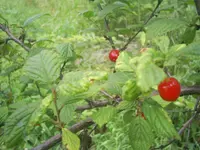
Install fine bird netting over a simple frame just before the fruit starts to blush to protect ripening cherries, removing it promptly after harvest to avoid trapping wildlife while growing Nanking cherry.

Dormant Disease Prevention

In late winter, before bud break, apply a labeled dormant oil or copper spray according to instructions to reduce overwintering insect pests and fungal spores on stems and buds.

Common Pests and Diseases

Cherry leaf spot

This disease causes small purple to reddish spots on leaves that later turn brown, often leading to premature leaf drop in mid to late summer.

Solution

Collect and destroy fallen leaves, prune to improve airflow, and avoid overhead watering; in areas with a history of the problem, apply a labeled copper or chlorothalonil fungicide at petal fall and repeat as recommended to protect new foliage as part of Prunus tomentosa care instructions.

Brown rot

This disease attacks blossoms and fruit, causing blossom blight, twig dieback, and soft brown fruit rot often covered with tan spore masses.

Solution

Prune out and dispose of blighted twigs and any remaining mummified fruit, thin branches to improve air circulation, and use a bloom-time fungicide labeled for brown rot on cherries if the shrub has a history of infections.

Aphids

These insects cluster on young shoots and leaf undersides, causing curling, distortion, and sticky honeydew that can lead to sooty mold on leaves and stems.

Solution

Spray colonies off with a strong stream of water, encourage natural predators such as lady beetles, and if needed treat new growth with insecticidal soap or horticultural oil, ensuring thorough coverage of shoot tips and leaf undersides.

Japanese beetles

These insects skeletonize foliage by eating the leaf tissue between veins, and heavy feeding can defoliate shrubs in midsummer.

Solution

Handpick beetles in the early morning into soapy water, protect high-value shrubs with fine netting during peak flight, and if populations are heavy consider using a contact insecticide labeled for ornamental cherries, applied according to label timing and safety directions.

Cytospora canker

This disease causes sunken, dead areas on branches and stems, often with gumming and progressive dieback of affected limbs.

Solution

Prune out infected branches several inches below visible symptoms during dry weather, disinfect pruning tools between cuts, reduce stress with proper watering and mulching, and avoid trunk and bark injuries that provide entry points for the fungus.

Interesting Facts

Unusual leaf hairiness

The leaves are densely covered with fine hairs on both surfaces, which reduce water loss and can make the foliage feel slightly velvety to the touch.

Cold-climate fruiting shrub

This species flowers and fruits reliably in regions with cold winters, tolerating temperatures well below freezing while still producing early spring blossoms and tart edible cherries.

High wildlife value

The dense branching and heavy fruit set provide shelter and food for birds and small mammals, so hedges of this shrub can significantly increase backyard wildlife activity.

Botan icon

Did you know?

Nanking cherry was introduced to North America in the late 19th and early 20th centuries and has since been widely used by agricultural experiment stations and shelterbelt projects on the Great Plains as a hardy, fruiting windbreak shrub that helps control erosion and withstands harsh continental climates.

FAQs about Nanking cherry

The fruits are edible and usually safe when ripe, commonly used fresh, in jams, or for wine. Avoid eating large quantities of seeds, which contain cyanogenic compounds that can release small amounts of toxic hydrogen cyanide.

Grow Healthy Plants with Botan Care

Keep your plants happy and healthy with plant identification, disease detection, and easy care guidance.

Botan plant care app — identify plants on mobile

Explore More Plants