



dragon fruit Identification (Selenicereus undatus)

Recognize dragon fruit by its climbing, three-angled cactus stems with wavy margins and short spines at each areole. Stems are thick, leafless, and branch irregularly.

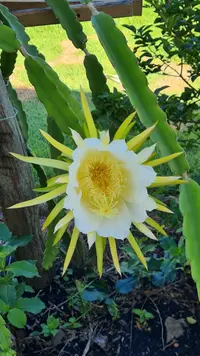
Mature plants also produce very large white flowers, often 10-14 inches (25-35 cm) long, from the stem edges.

Selenicereus undatus Identification

Identify Your Plant with Botan

Take a photo and use Botan to confirm your plant identification.

Clear images work best. Avoid photos taken too close or too far away

Check the stem shape, climbing habit, flowers, and fruit on Selenicereus undatus.

  • Long, climbing cactus stems are flat-sided and usually 3-angled, with wavy margins.
  • Aerial roots often emerge along the stem edges, helping it cling to supports.
  • Areoles sit on the margins and carry short spines, usually 1-3 per areole.
  • Flowers are very large, white, funnel-shaped, and about 10-14 inches (25-35 cm) across.
  • Fruit is oval to round, pink to red, with broad green scales on the skin.

Visible stems plus scaled fruit usually confirm it quickly.

Selenicereus undatus shows clear visual shifts from flat juvenile stems to flowering, fruiting vines.

  • Juvenile plant: Early growth is sparse and upright to arching, with narrow, flattened green stem segments and shallow scalloped margins; aerial roots are few or absent.
  • Mature plant: Older plants become long, climbing or cascading vines with thicker three-angled stems, stronger lobing, frequent aerial roots, and heavier branching from established supports.
  • Flowering stage: At this stage, large white funnel-shaped flowers open from stem edges, often 10-14 inches (25-36 cm) long, with many narrow outer segments.
  • Fruiting stage: After flowering, oval to round pink to red fruits form along stem margins, replacing flowers with fleshy, scale-covered bodies typical of dragon fruit.

The clearest seasonal shift is flowering. In warm-season bloom periods, Selenicereus undatus produces very large, white, night-opening flowers along the stem margins, adding a brief but distinctive identification feature. After flowering, oval to round red or pink-skinned dragon fruit may become visible and remain noticeable for a time. Outside bloom and fruiting periods, the plant usually keeps the same green, three-angled stems year-round.

Several climbing cacti are regularly mistaken for dragon fruit.

yellow pitahaya(Selenicereus megalanthus)

Often confused because both are climbing, three-angled cacti grown for pitahaya fruit. Yellow pitahaya usually has narrower stems with more pronounced spines along the margins, and its ripe fruit is yellow rather than red or pink.

queen of the night(Epiphyllum oxypetalum)

Confusion happens when plants are seen without fruit because both are sprawling epiphytic cacti with large night-blooming white flowers. Epiphyllum oxypetalum has broad, flat leaf-like stems, while dragon fruit has thick, three-sided stems with scalloped edges.

Selenicereus undatus is native to parts of southern Mexico and Central America. It occurs in tropical dry forest and seasonally moist woodland, often climbing on trees or scrambling over rocks. That habitat helps with identification because this species is naturally an epiphytic or lithophytic cactus, meaning it grows on trees or rocks rather than rooted in open desert ground.

  • Stem spines: The climbing stems have small spines. Skin contact can cause minor punctures or scratches in humans and pets during handling.
  • Fruit skin and handling: The fruit is not a poisoning concern, but the outer skin often carries small scales and nearby stem spines. Injury risk is from contact, not ingestion, especially when cutting fruit from the plant.

Confirm the Species with Botan

Use a photo to identify or verify the plant, which helps avoid mix-ups before you label it or compare similar plants.

FAQ

Yes. This cactus has small spines at the areoles, the tiny cushion-like points along stem edges. They are usually short and sparse rather than long or densely armed, which helps in dragon fruit identification.

More Plant Identification Guides

Scan Your Plant. Get the Details.

Identify a plant from a photo, then see species-specific care information, safety notes, and common problems.

Botan app identifying a plant from a photo
What Plants Don't Like Epsom Salt?

11 min read · 29 Jul 2026

What Plants Don't Like Epsom Salt?

Learn which plants can be seriously damaged by Epsom salt and which will thrive on it. We’ll explain when and how to use it properly, provide tips for indoor & outdoor plants — read on and enjoy a healthy garden.

Plant Care
What Plants Don't Like Epsom Salt?
Is Sugar Water Good for Plants?

4 min read · 14 Sept 2026

Is Sugar Water Good for Plants?

Sugar water may sound like an easy boost, but most rooted plants do not need extra sucrose. This guide explains how green tissues produce carbohydrates, when a sweetened solution can be useful, and why too much can cause problems.

Plant Care
Is Sugar Water Good for Plants?
Top 5 Best Indoor Plants for Air Quality

5 min read · 11 Sept 2026

Top 5 Best Indoor Plants for Air Quality

Indoor plants can make a room feel fresher thanks to their air-purifying qualities. Here are 5 of the most suitable choices for your routine and living space.

Plant Recommendations
Top 5 Best Indoor Plants for Air Quality