Gongora leucochila Care

Gongora leucochila

About Gongora leucochila

Gongora leucochila is an epiphytic orchid, usually found hanging from tree branches rather than growing in soil. It forms arching inflorescences with many nodding, fragrant flowers, often in earthy tones with pale lips.

This species is native to tropical forests of Central and South America, where it grows in warm, humid, shaded conditions with good air movement. It can be moderately challenging, as it dislikes drying out completely and reacts poorly to stagnant, compact media.

Growers who learn how to care for Gongora leucochila usually focus on stable warmth, high humidity, and airy orchid substrates that drain quickly but retain constant light moisture.

Main Plant Requirements

Care Difficulty

Hard Care

Light Preference

Bright Indirect Light

Water Requirements

Keep Soil Moist

Temperature Preference

Tropical / Frost Sensitive

Hardiness Zone

Unknown

Soil Texture

Peaty, Organic-rich

Soil pH

Acidic (5.5–6.5)

Soil Drainage

Moist but well-drained

Fertilization

Moderate (every 2–4 weeks)

Get Personalized Care Plan

Scan your plant to receive care tips personalized for your specific plant

Available on iOS and Android

How to Care for the Gongora leucochila

This species prefers bright, filtered light similar to a lightly shaded forest canopy.

  • Provide 8–10 hours of bright, indirect light daily, with gentle morning sun and protection from strong midday and afternoon sun.
  • Grow Gongora leucochila under 50–70% shade cloth or behind sheer curtains to diffuse rays and prevent leaf scorch or yellow patches from excess light.
  • If growth is weak, leaves dark, and flowering poor, increase light slightly; in summer, move plants a bit deeper into shade to avoid overheating.

This orchid prefers evenly moist but never waterlogged conditions around the roots.

  • Water when the top 1–2 cm of the medium feels just barely dry, using thorough soakings that fully drain away to avoid stagnant water around pseudobulbs.
  • In spring and summer, expect to water more often as new growth and higher temperatures increase demand; in fall and winter, extend the interval once growth slows.
  • Watch for wrinkling pseudobulbs and dry, papery roots as signs of underwatering, and soft, blackened roots or a sour smell as signs of overwatering or poor drainage.

This orchid thrives in consistently warm, humid conditions without abrupt temperature swings.

  • Aim for 70–80°F (21–27°C) by day and 60–68°F (16–20°C) at night to support strong growth and flowering.
  • Avoid exposing plants below 55°F (13°C); brief dips to 50°F (10°C) may be tolerated but can slow growth and increase stress, especially in damp conditions.
  • Protect from heat above 90°F (32°C) with extra shade, air movement, and humidity, since prolonged high temperatures can cause leaf burn, bud blast, and root stress.

This orchid needs consistently high humidity to grow well indoors.

  • Aim for 60–80% humidity, as Gongora leucochila comes from very moist, tropical forest habitats.
  • Dry air causes leaf tip browning, accordion-like leaf pleats, shriveled pseudobulbs, and stalled new growth.
  • Increase humidity with a room humidifier, grouped plants, and a wide pebble tray kept wet below but not touching the pot base.

This epiphytic orchid needs a very airy, fast-draining medium rather than traditional soil.

  • Use a coarse mix of medium orchid bark, chunky perlite, and sphagnum moss or coconut husk chips to hold some moisture without becoming dense.
  • Ensure rapid drainage; water must flow through within seconds, leaving air spaces around roots to prevent suffocation and rot.
  • Target slightly acidic to neutral conditions (about pH 5.5–7.0), which most orchid bark-based mixes naturally provide.
  • Avoid fine potting soil, dense peat-heavy mixes, or unmodified garden soil, which compact around roots and trap water.

This species is well suited to container growing, especially in hanging baskets or ventilated pots.

  • Choose slotted or basket-style containers that let air reach the roots and allow spent water to drain away quickly.
  • Secure the pot or basket so it remains stable under the weight of arching flower spikes and moist potting medium.
  • Select a container just large enough for 1–2 years of growth so the open mix does not stay wet for too long after watering.

This orchid benefits from light, consistent feeding during its active growth period.

  • Use a balanced orchid fertilizer (around 20-20-20) diluted to 1/4–1/2 strength for caring for Gongora leucochila.
  • Feed every 1–2 weeks in spring and summer when new growth and roots are developing.
  • Reduce feeding to once a month or stop entirely in fall and winter when growth slows.
  • Flush the pot with plain water monthly to prevent fertilizer salt buildup around the roots.

Pruning needs for Gongora leucochila are minimal and focus on hygiene rather than shaping.

  • Best time to trim is after flowering or during active growth, avoiding buds and spikes in development.
  • Remove dead, yellowing, or damaged leaves and spent flower spikes with clean, sharp scissors or pruning snips.
  • Cut back only to healthy tissue, leaving pseudobulbs intact to support future growth and flowering.
  • Disinfect tools before and after use to limit spread of fungal or bacterial problems between plants.

This orchid grows best when slightly root-bound and only needs repotting when clearly overcrowded.

  • Repot every 2–3 years, or when roots circle the container, medium breaks down, or growth slows.
  • Time repotting for early spring or just after flowering, when new roots are starting to emerge.
  • Use a shallow, well-drained pot with fresh fine to medium orchid bark and optional sphagnum for moisture.
  • Gently loosen roots, remove decayed medium, and keep the plant shaded, warm, and slightly moist afterward to limit stress.

Gongora leucochila is usually propagated by division rather than from seed in home collections.

  • Divide only mature clumps in spring when new growth and roots are emerging.
  • Ensure each division carries at least 3–4 healthy pseudobulbs to maintain vigor.
  • Plant divisions in fresh orchid bark mix, keeping roots just covered and the base stable.
  • Provide high humidity, bright filtered light, and gentle air movement to support establishment.

This tropical orchid is frost-sensitive and needs warm, sheltered conditions in winter.

  • Keep temperatures above 60°F, avoiding exposure to freezing drafts or unheated spaces.
  • Move container plants indoors or to a heated greenhouse before night temperatures drop below 55°F.
  • Maintain bright, indirect light and slightly drier medium, without letting roots stay bone dry.
  • Avoid cold water on roots and foliage; use room-temperature water during winter.

Care Tips

Choose airy mounts

Grow this species on cork bark, tree fern, or in open mesh baskets with coarse media so the pendent inflorescences can hang freely without kinking or rotting in the potting mix.

Rotate for even spikes

Turn the plant 90° every 1–2 weeks during spike initiation so flower spikes develop evenly around the plant instead of crowding one side toward the brightest light source.

Secure emerging spikes

As spikes elongate, gently guide and clip them to the outside of the basket or mount using soft ties, taking care not to bend them sharply, which can abort buds.

Improve air movement

Use a small oscillating fan on a low setting aimed past, not directly at, the plant to keep the long spikes and succulent roots dry on the surface while the medium stays evenly moist.

Plan for seasonal rest

In late autumn, track your local light and temperature changes and slightly extend the interval between waterings instead of stopping abruptly, which supports a smooth transition into the lighter winter rest typical when growing Gongora leucochila.

Common Pests and Diseases

Scale insects

This pest feeds on orchid sap, often hiding on flower spikes, under leaves, and around pseudobulb sheaths, causing yellowing and general decline. Symptoms include sticky honeydew and sooty mold developing on affected areas.

Solution

Isolate the plant, then wipe infested areas with cotton pads dipped in isopropyl alcohol, paying close attention to the bases of pseudobulbs and the undersides of leaves. Improve air movement, avoid overfertilizing, and repeat spot treatments every 7–10 days until no new insects appear; for heavy infestations, use a labeled systemic insecticide suitable for orchids.

Spider mites

These insects thrive on Gongora foliage in warm, dry air and can quickly cause fine stippling, dull leaves, and webbing along the leaf midrib and edges. Symptoms include thin, leathery leaves that yellow prematurely, especially in low-humidity setups.

Solution

Rinse foliage thoroughly with a strong but gentle stream of lukewarm water, including the leaf undersides, then raise humidity to around 60–70% while maintaining good airflow. For persistent populations, apply a miticide or insecticidal soap labeled for orchids, repeating at 5–7 day intervals to disrupt the life cycle.

Snails and slugs

This pest is especially attracted to moist orchid media and can chew soft pseudobulbs, roots, and emerging flower spikes at night, leaving irregular holes and slime trails. Symptoms include missing root tips and aborted spikes in hanging baskets or mounts.

Solution

Inspect plants at night and hand-pick any snails or slugs, then use barriers such as copper tape on benches or hanging supports and place iron phosphate bait away from direct plant contact. Keep bench areas clean and avoid leaving wet debris or old sphagnum that provides hiding sites.

Bacterial soft rot

This disease causes rapidly spreading, water-soaked lesions on pseudobulbs and leaf bases, which soon become mushy and foul-smelling in warm, stagnant conditions. Symptoms include sudden collapse of parts of the plant, especially around crowded, moist new growths.

Solution

Immediately remove and discard all affected tissue with a sterile blade, cutting well into healthy tissue, then dust cuts with cinnamon or a bactericide labeled for orchids. Increase air circulation, reduce leaf wetness, avoid water sitting in leaf axils, and slightly lower watering frequency until new growth appears healthy.

Leaf spot fungi

This disease appears as small, dark, sometimes sunken spots on Gongora leaves, often following periods of high humidity and poor airflow, especially in tight growing spaces. Symptoms include gradual coalescing of spots and premature yellowing of older leaves.

Solution

Trim off heavily spotted leaves with sterile tools and discard them, then allow foliage to dry quickly after watering by improving air movement and avoiding evening misting. If spotting continues, apply a broad-spectrum fungicide approved for orchids at the recommended interval while also spacing plants to reduce overcrowding, which supports better Gongora leucochila care.

Interesting Facts

White-lipped flower detail

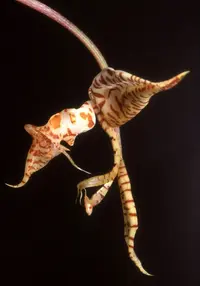
The species name leucochila refers to its pale, often white labellum margin, a lip-like petal that contrasts with the darker petals and sepals and helps guide pollinators toward the reproductive structures.

Specialized pollinia structure

Like many Gongora species, it produces compact pollen masses called pollinia, but in G. leucochila these are precisely positioned under a hinged column so that only specific visiting insects can remove and transfer them effectively.

Pendant inflorescence habit

G. leucochila forms arching or pendant flower spikes that hang below the plant, an adaptation that exposes the flowers in humid understory air currents where its scent and visual cues are more easily detected by canopy-dwelling pollinators.

FAQs about Gongora leucochila

Lack of blooms usually comes from insufficient light, too-warm nights, or irregular fertilizing. This orchid needs a distinct, slightly cooler, drier rest after new growth matures. If growth never rests, flowering is often poor or absent.

Grow Healthy Plants with Botan Care

Keep your plants happy and healthy with plant identification, disease detection, and easy care guidance.


Botan plant care app — identify plants on mobile

Explore More Plants