


Elevated planting mounds
Plant on a low gravel mound or slight slope so excess rainwater drains quickly away from the root zone, which greatly reduces rot risk in wet seasons.

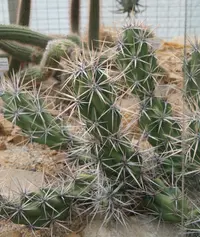
Dagger cholla (Grusonia invicta) is a small, low-growing cactus known for its thick, cylindrical joints covered in very long, rigid spines. It forms dense, sprawling mats that can look almost like a tangle of barbed branches.
This species is native to arid regions of northern Mexico and the southwestern United States, where it grows in rocky, well-drained desert soils. Its extreme drought tolerance and slow growth make it relatively easy to maintain if kept dry and bright.
Spines are the main challenge when owners care for dagger cholla, since handling requires caution. It prefers strong light, minimal watering, and gritty, fast-draining soil to stay healthy in cultivation.

Care Difficulty
Moderate Care

Light Preference
Full Sun

Water Requirements
Low Water

Temperature Preference
Warm Climate

Hardiness Zone
8–10

Soil Texture
Sandy, Rocky, Loamy

Soil pH
Slightly acidic (6.5–7.0), Slightly alkaline (7.0–7.5)

Soil Drainage
Well-drained

Fertilization
Minimal (feed rarely)
Scan your plant to receive care tips personalized for your specific plant
Available on iOS and Android
This desert cactus needs very bright light and thrives in full sun exposures.
This species is highly drought-tolerant and must dry thoroughly between waterings.
This cactus tolerates wide temperature swings but performs best in warm, arid conditions.
This cactus prefers very dry air and rarely suffers from low indoor humidity.
This cactus needs very fast-draining, mineral soil to prevent root and stem rot.
This species is suitable for container growing when drainage and stability are carefully managed.
This desert cactus needs only light feeding, as dagger cholla evolved in very low-nutrient soils.
Grusonia invicta needs minimal pruning, mainly to maintain safety and plant health.
This cactus is usually grown in the ground, but container plants or crowded clumps may need occasional transplanting.
Grusonia invicta is commonly propagated from stem segments, with seeds used mainly by collectors or specialists.
This hardy cactus tolerates substantial cold when kept dry but still benefits from thoughtful winter management.

Plant Health Check
Not sure what's wrong with your plant? Check your plant's health inside the app.
This cactus can shed entire stem segments when disturbed, a process called segment abscission, leaving barbed joints attached to animals or shoes while the main plant survives and later resprouts from the base.
Unlike many cacti, it tolerates substantial frost and cold, surviving in semi-arid grasslands and scrub of the southwestern United States where winter temperatures regularly fall below freezing.
The stems carry dense clusters of sharply hooked spines with microscopic barbs that easily snag passing animals, which helps disperse detached stem joints across the landscape.

This species is considered a problematic rangeland weed in parts of the southwestern United States because its easily detached, barbed stem joints form dense, spreading colonies that injure livestock and are difficult to control mechanically.
This species spreads slowly by segmented stems that root where they touch soil. It is not generally aggressive, but in very dry, open sites it can gradually form dense clumps that are difficult to handle due to spines.
Keep your plants happy and healthy with plant identification, disease detection, and easy care guidance.

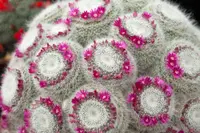
Old Lady Cactus
Mammillaria hahniana

Acanthocalycium spiniflorum
Acanthocalycium spiniflorum
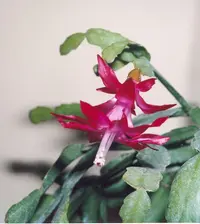
Schlumbergera × buckleyi
Schlumbergera × buckleyi
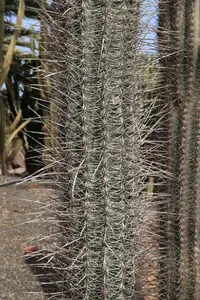
Lemaireocereus hollianus
Lemaireocereus hollianus
mountain ball cactus
Pediocactus simpsonii
Sacred Column Cactus
Trichocereus macrogonus
Oroya peruviana
Oroya peruviana

Acanthocalycium leucanthum
Acanthocalycium leucanthum