Flowering reset period
After flowering finishes, provide a 4–6 week rest with slightly cooler temperatures and minimal disturbance to help set strong buds for the next season.

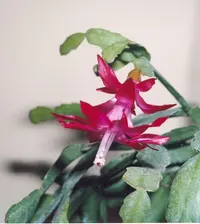
Schlumbergera × buckleyi, commonly called the Christmas cactus, is an epiphytic cactus that naturally grows on trees and rocks in the coastal mountains of Brazil. It forms arching, segmented stems and produces showy, tubular flowers in winter. Unlike desert cacti, it prefers mild conditions with consistent moisture and good air circulation. Its flattened stems store some water but still need a well-drained, airy potting mix. This species is considered relatively forgiving for indoor growers if extremes in watering and temperature are avoided. Understanding how to care for Schlumbergera × buckleyi helps keep it blooming reliably year after year.

Care Difficulty
Moderate Care

Light Preference
Bright Indirect Light

Water Requirements
Moderate Water

Temperature Preference
Tropical / Frost Sensitive

Hardiness Zone
11–12

Soil Texture
Loamy, Peaty, Organic-rich

Soil pH
Acidic (5.5–6.5), Slightly acidic (6.5–7.0)

Soil Drainage
Moist but well-drained

Fertilization
Light (every 4–6 weeks)
Scan your plant to receive care tips personalized for your specific plant
Available on iOS and Android
This forest cactus prefers bright, indirect light that mimics dappled tree canopies.
Watering should keep the root zone lightly moist but never saturated.
This plant prefers mild, stable temperatures with a cooler period to support flowering.
This species prefers moderate to slightly high humidity for stable flowering and segment health.
This epiphytic cactus needs a loose, fast-draining, organic-rich mix that still holds some moisture.
This species is very suitable for container growing due to its shallow, fibrous root system.
Nutrient support helps Schlumbergera × buckleyi maintain strong growth and flowering in containers.
Thoughtful pruning keeps the plant compact, encourages branching, and supports flowering.
Repotting maintains healthy roots and stable moisture in a long-lived plant.
Stem cuttings are the standard way to produce new plants from mature specimens.
Cool, frost-free winter conditions support bud formation and long-term health.

Plant Health Check
Not sure what's wrong with your plant? Check your plant's health inside the app.
This plant is a historical hybrid first raised in 19th‑century Britain by crossing Brazilian forest cacti species, and it became widely popular in Victorian glasshouse collections for its winter flowering display.
Its stem segments have a characteristic scalloped, zigzag outline that is noticeably more rounded and less sharply toothed than the related Thanksgiving cactus group, which helps with correct identification.
The tubular, pendent flowers are adapted to open and function best in low light, reflecting their ancestry as epiphytes in shaded Atlantic rainforest canopies where nocturnal pollinators such as moths are active.

In long‑established family collections, this hybrid has been documented to survive and flower reliably for several decades, often being passed down through generations as a single clone propagated by cuttings, which makes many old household plants genetically identical descendants of 19th‑century stock.
Lack of blooms usually comes from too much light at night, warm temperatures in fall, or no short rest period. Provide cooler nights, 12–14 hours of darkness, and avoid moving buds once they form.
Keep your plants happy and healthy with plant identification, disease detection, and easy care guidance.