


Rigid pot choice
Use a heavy terracotta or clay pot with a drainage hole to keep the shallow root system stable and prevent the round body from rocking or tipping as it enlarges and flowers.


Acanthocalycium leucanthum is a small, globular to short-columnar cactus native to arid regions of Argentina. It usually stays compact and forms a single stem with pronounced ribs and strong spines. In season it produces large, showy white to cream flowers near the top of the plant, creating a striking contrast with the dark green body. This species is adapted to high light, low moisture, and very free-draining, mineral-rich soils. Its slow growth and drought tolerance make it suitable for containers and small spaces, but it is sensitive to overwatering and poor drainage. With stable light and careful watering, it is relatively straightforward to care for Acanthocalycium leucanthum.

Care Difficulty
Moderate Care

Light Preference
Full Sun

Water Requirements
Low Water

Temperature Preference
Warm Climate

Hardiness Zone
9–11

Soil Texture
Sandy, Loamy, Rocky

Soil pH
Slightly acidic (6.5–7.0), Neutral (7.0)

Soil Drainage
Well-drained

Fertilization
Minimal (feed rarely)
Scan your plant to receive care tips personalized for your specific plant
Available on iOS and Android
This cactus thrives in bright, direct sun but adapts to some light variation.
Watering should be infrequent and based on soil dryness rather than a fixed schedule.
This species prefers warm conditions and must be protected from frost.
This small desert cactus handles typical indoor humidity easily without special adjustments.
This cactus needs a very fast-draining, mineral-rich substrate to prevent root and stem rot.
This species is well suited to container cultivation when drainage and stability are prioritized.
This cactus benefits from light feeding during active growth but is sensitive to excess nutrients.
Pruning needs are minimal and focus mainly on health and safety.
This slow-growing cactus needs infrequent repotting but benefits from fresh, sharply drained soil.
Propagation is usually done from seed, as offsets are uncommon on this species.
This cactus prefers cool, dry winter conditions and does not tolerate prolonged hard frost.

Plant Health Check
Not sure what's wrong with your plant? Check your plant's health inside the app.
The large white flowers open mainly at night or in the very early morning, matching the activity of nocturnal and crepuscular pollinators. Each bloom is short-lived, often lasting only about a day.
The tubular, white, strongly scented flowers are adapted to pollination by night-flying moths, which are attracted by pale colors and fragrance in low light. This pollination strategy is typical of many South American cactus species from open habitats.
Its dense, radial spines help shade the stem surface, reducing overheating and sun damage in its native sunny habitats of northern Argentina. The spines also create a small layer of still air around the stem that limits water loss.

This species naturally occurs at relatively low to mid elevations in northern Argentina, often on rocky, well-drained slopes, where its solitary or loosely clustering globular stems blend with stones and gravel, providing camouflage against herbivores.
This cactus performs best outdoors in bright, dry conditions, but can adapt to a sunny windowsill or greenhouse. Indoors, provide maximum light, low humidity, and excellent drainage to avoid etiolation, rot, and weak growth.
Keep your plants happy and healthy with plant identification, disease detection, and easy care guidance.

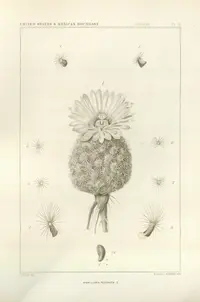
rhinoceros cactus
Coryphantha echinus
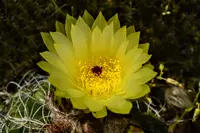
Cactus
Parodia ottonis
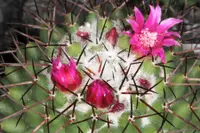
Mammillaria polythele
Mammillaria polythele
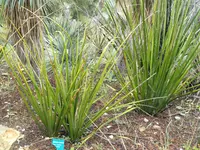
New Mexico false yucca
Hesperaloe funifera
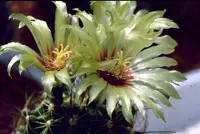
miniature barrel cactus
Thelocactus setispinus
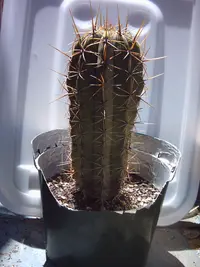
Sacred Column Cactus
Trichocereus macrogonus
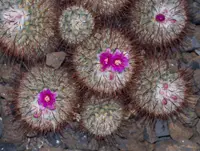
Silken Pincushion Cactus
Mammillaria bombycina
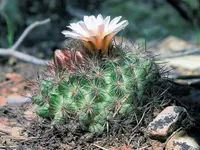
mountain ball cactus
Pediocactus simpsonii