Offset management
Inspect the base yearly and gently twist off well-rooted offsets with a sterile knife if needed, then replant them in their own pots to prevent overcrowding and maintain good airflow around the mother plant.

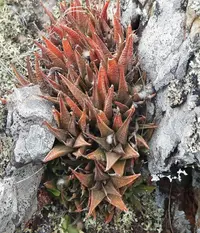
Breede haworthia (Haworthiopsis venosa) is a compact, slow-growing succulent valued for its tough, triangular leaves and neat rosette shape. It stays small, which makes it suitable for windowsills, desks, and small containers. The leaves often show translucent streaks or patterns and can flush darker tones under stronger light. In nature, H. venosa occurs in South Africa, often tucked between rocks or in shallow, gritty soils that drain very quickly. Its drought tolerance and modest growth rate make it relatively easy for beginners, as long as overwatering is avoided. For those learning how to care for Breede Haworthia, bright indirect light, fast-draining soil, and light but consistent watering during active growth are usually enough.

Care Difficulty
Easy Care

Light Preference
Bright Indirect Light

Water Requirements
Low Water

Temperature Preference
Tropical / Frost Sensitive

Hardiness Zone
10–11

Soil Texture
Sandy, Loamy, Rocky

Soil pH
Acidic (5.5–6.5), Slightly acidic (6.5–7.0)

Soil Drainage
Well-drained

Fertilization
Minimal (feed rarely)
Scan your plant to receive care tips personalized for your specific plant
Available on iOS and Android
This compact succulent prefers bright, indirect light with limited direct sun exposure.
Watering should mimic dry habitats and allow the roots of Haworthiopsis venosa to breathe between soakings.
This species prefers warm, stable conditions and is sensitive to frost.
Haworthiopsis venosa handles typical indoor humidity well and rarely needs adjustment.
This species needs a very fast-draining, mineral-heavy substrate that dries quickly between waterings.
Haworthiopsis venosa is very suitable for container culture, including on windowsills and desks.
This compact succulent has low nutrient demand but responds well to light feeding during active growth for optimal Haworthiopsis venosa plant care.
Haworthiopsis venosa needs minimal pruning, mainly to maintain a clean, compact rosette.
This slow-growing succulent prefers tight pots and infrequent repotting in a very well-drained mix.
New Haworthiopsis venosa plants are most reliably produced by division of offsets rather than seed.
This succulent is not frost hardy and needs careful winter management, especially in cold climates.

Plant Health Check
Not sure what's wrong with your plant? Check your plant's health inside the app.
The upper leaf surfaces develop translucent, window-like areas that allow light to penetrate into the inner tissues, an adaptation to low, filtered light in its native habitats.
The leaves show a pronounced network of raised veins that inspired the species name venosa, and this venation remains visible even on older leaves, making it a useful identification feature among related haworthias.
This species is naturally restricted to parts of South Africa’s Western Cape, where it grows in rocky, often quartz-rich soils, frequently shaded by surrounding shrubs or grasses.
Brown leaf tips or patches usually result from underwatering, very low humidity, or sun scorch. Check the roots, adjust watering slightly, and move the plant away from intense direct sun to prevent further tissue damage.
Keep your plants happy and healthy with plant identification, disease detection, and easy care guidance.