Dial-in fresh air
Provide steady but gentle fresh air exchange in the grow space by using a small fan on low, pointing past rather than directly at the blocks, to reduce CO₂ buildup and keep caps compact without drying them out.

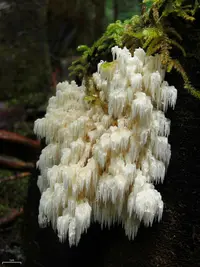
Bear's head (Hericium abietis) is a wood-decaying fungus, not a leafy plant. It produces cascading, icicle-like white spines that hang in dense clusters from conifer logs and stumps. In nature it is found in coniferous forests of western North America, especially on decaying fir and spruce wood. This species has a relatively specific habitat, so it is less common in cultivation than some other Hericium species. For growers, the main challenges are providing the right wood-based substrate, cool to mild temperatures, and consistently high humidity. Understanding how to care for Bear's head starts with mimicking its cool, moist, shaded forest environment as closely as possible.

Care Difficulty
Hard Care

Light Preference
Shade

Water Requirements
Keep Soil Moist

Temperature Preference
Cool Climate

Hardiness Zone
Unknown

Soil Texture
Organic-rich, Loamy

Soil pH
Acidic (5.5–6.5)

Soil Drainage
Moist but well-drained

Fertilization
Minimal (feed rarely)
Scan your plant to receive care tips personalized for your specific plant
Available on iOS and Android
This wood-inhabiting fungus prefers cool, shaded forest light rather than open sun.
This fungus needs consistently moist, not saturated, conditions around its woody substrate to form healthy fruiting bodies.
This species prefers cool to mild conditions similar to shaded conifer forests.
This wood-decay fungus needs consistently high humidity to form and maintain healthy fruiting bodies.
Hericium abietis grows on conifer wood, so cultivation uses a wood-based substrate rather than garden soil.
This species is suitable for container-style cultivation when grown in bags, tubs, or buckets with a wood-based substrate.
Hericium abietis grown on logs or sawdust blocks relies mainly on the nutrients in its substrate, so only modest supplementation is useful.
Pruning Hericium abietis is minimal and focuses on hygiene and reliable fruiting rather than shaping.
This fungus is not a true potted plant; care focuses on renewing or moving its inoculated substrate rather than classic repotting.
Reproducing Hericium abietis for cultivation relies on controlled fungal techniques rather than standard plant propagation methods.
Outdoor Bear's head on logs is fairly cold tolerant, so winter care focuses on preventing extreme drying or freeze-thaw damage.

Plant Health Check
Not sure what's wrong with your plant? Check your plant's health inside the app.
This species is strongly associated with conifer wood, especially fallen logs and stumps of true firs (Abies) in western North American forests, rather than broadleaf hosts used by many other Hericium species.
The fruiting body forms dense clusters of hanging spines that are typically shorter and more tufted than those of closely related lion’s mane, giving it a more compact, shrub-like appearance on the log surface.
It occurs primarily in the Pacific Northwest and parts of western North America, where cool, moist conifer forests and abundant decaying fir wood create the specific substrate conditions it requires.

Molecular studies have shown that this species is genetically distinct from the more widely known lion’s mane (Hericium erinaceus), helping clarify species boundaries within the genus and improving accurate identification in ecological surveys.
This fungus is considered edible and is sometimes foraged, but correct identification is critical, as some look-alike species may cause illness. Only eat specimens identified by an experienced mycologist and always cook thoroughly before consumption.
Keep your plants happy and healthy with plant identification, disease detection, and easy care guidance.