Wind-hardening young trees
Stake only very young or top-heavy plants and gradually loosen and remove ties over 1–2 seasons so the trunk flexes slightly in wind and develops stronger supportive wood.

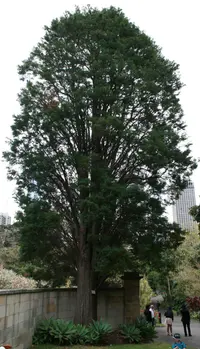
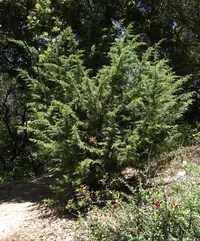
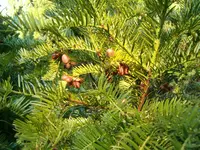
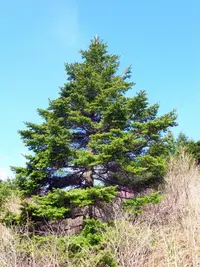
Mexican cedar, Hesperocyparis lusitanica, is an evergreen conifer grown mainly as a landscape or windbreak tree. It forms a dense, conical crown with soft, scale-like foliage and small cones.
This species is native to Mexico and Central America, where it grows in montane forests with mild, relatively moist conditions. In gardens it is valued for fast growth, year-round greenery, and tolerance of pruning, which makes it adaptable but potentially large.
It prefers full sun, well-drained soil, and moderate moisture, and resents waterlogged conditions. These traits make it relatively straightforward to care for Mexican cedar in suitable climates, but it is not ideal for small spaces.

Care Difficulty
Moderate Care

Light Preference
Full Sun

Water Requirements
Moderate Water

Temperature Preference
Cold Hardy

Hardiness Zone
7–10

Soil Texture
Sandy, Loamy, Rocky

Soil pH
Acidic (5.5–6.5), Slightly acidic (6.5–7.0)

Soil Drainage
Well-drained

Fertilization
Minimal (feed rarely)
Scan your plant to receive care tips personalized for your specific plant
Available on iOS and Android
Hesperocyparis lusitanica grows best in bright, open conditions with several hours of direct sun each day.
Hesperocyparis lusitanica prefers evenly moist but never saturated soil, especially during establishment.
This species prefers mild climates but copes with a fairly wide temperature range once established.
This species accepts a wide humidity range and usually does not need special humidity management outdoors.
Hesperocyparis lusitanica prefers well-structured, free-draining mineral soil to support deep, stable rooting.
This conifer can be grown in containers for several years, especially as a young screening or specimen plant.
This conifer grows well in average soil and benefits from light, targeted feeding rather than heavy fertilization.
Pruning Hesperocyparis lusitanica is mainly done to maintain structure and remove problem growth.
This species is most often grown in the ground, with transplanting more common than long-term container culture.
Hesperocyparis lusitanica is usually propagated by semi-hardwood cuttings or seeds under controlled conditions.
Established plants are generally cold hardy but young or container-grown trees benefit from some winter care.

Plant Health Check
Not sure what's wrong with your plant? Check your plant's health inside the app.
Despite common names like Mexican cedar or Mexican cypress, this species is a cypress in the Cupressaceae family, not a true cedar from the genus Cedrus.
It is naturally found in cool, moist highlands of Mexico and Central America, often between roughly 1,200–3,000 m elevation, where it experiences strong light but relatively mild temperatures.
This species has been widely used in breeding ornamental and shelterbelt cypresses, and some cultivated forms in Europe and elsewhere are hybrids where its genetic contribution has improved cold tolerance and growth rate.

Introduced to Europe centuries ago (historically under the name Cupressus lusitanica), this species became so established in Portugal that it was long mistaken as native there, influencing both formal garden design and windbreak planting across Mediterranean climates.
This species is generally fast-growing, often adding 30–90 cm per year in suitable conditions. Growth slows with age, poor soil, drought, or root restriction. Regular light pruning helps maintain a balanced structure without significantly reducing growth.
Keep your plants happy and healthy with plant identification, disease detection, and easy care guidance.