fringed rosemallow Care (Hibiscus schizopetalus)

Also known as: Spider Hibiscus, Lantern Hibiscus, Coral Hibiscus
fringed rosemallow

About fringed rosemallow

Fringed rosemallow (Hibiscus schizopetalus) is an evergreen shrub in the mallow family, valued for its finely cut, dangling flowers and graceful, arching branches. It often reaches small shrub or patio-tree size in warm climates.

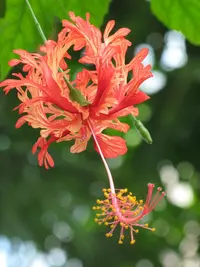
The flowers have long, narrow, deeply fringed petals and a protruding floral column, giving a delicate, lantern-like look. Leaves are medium green, thin, and slightly toothed.

This species is native to tropical East Africa and thrives in consistently warm, humid conditions. It prefers bright light, regular moisture, and well-drained, fertile soil.

In cooler regions it is usually grown in containers or greenhouses, and some gardeners find it slightly demanding until they learn how to care for fringed rosemallow.

Main Plant Requirements

Care Difficulty

Moderate Care

Light Preference

Full Sun

Water Requirements

Regular Water

Temperature Preference

Tropical / Frost Sensitive

Hardiness Zone

10–11

Soil Texture

Loamy, Sandy, Organic-rich

Soil pH

Acidic (5.5–6.5), Slightly acidic (6.5–7.0)

Soil Drainage

Moist but well-drained

Fertilization

Moderate (every 2–4 weeks)

Get Personalized Care Plan

Scan your plant to receive care tips personalized for your specific plant

Available on iOS and Android

How to Care for the fringed rosemallow

This tropical shrub needs abundant light to flower well and stay compact.

  • Provide 6–8 hours of direct sun daily; morning sun with light afternoon shade works best, especially in hot summers.
  • Tolerates light partial shade, but fringed rosemallow will produce fewer blooms and longer, sparser growth if it receives less than 4–5 hours of direct sun.
  • In very intense summer climates, protect from harsh midafternoon sun with filtered light to prevent leaf scorch and bud drop.

Moist, well-drained soil supports continuous flowering and healthy growth.

  • Allow the top 2–3 cm of soil to dry before watering, then soak the root zone thoroughly so moisture reaches the full root depth.
  • In hot, active growth periods, expect to water more often; in cooler weather or reduced light, extend the interval as drying slows.
  • Watch leaves and soil: wilting and crisp edges suggest underwatering, while yellowing leaves, soft stems, and sour-smelling, soggy soil indicate excess moisture for Hibiscus schizopetalus.

Consistent warmth is essential for strong growth and flowering.

  • Ideal growth occurs at 68–85°F (20–29°C), with the best flowering usually between 70–82°F (21–28°C).
  • This species is very sensitive to cold; growth slows below 60°F (16°C) and tissue damage often occurs near 40°F (4°C).
  • Protect from frost at all times, and in heat waves above 95°F (35°C) provide light shade and extra airflow to reduce stress and leaf scorch.

This species prefers moderately high humidity to keep foliage and blooms healthy.

  • Aim for 50–70% humidity; prolonged air below 40% can cause leaf edge browning and bud drop.
  • Watch for curled leaves, crispy tips, and stalled flower development as signs of low humidity stress.
  • Increase humidity with a pebble tray under the pot, grouping plants, or a small room humidifier near fringed rosemallow.

Hibiscus schizopetalus grows best in moist, well-aerated, organic-rich soil that drains freely.

  • Use a loamy mix of roughly 2 parts peat or coco coir, 1 part compost, and 1 part perlite or coarse sand for structure and drainage.
  • Aim for slightly acidic to neutral pH around 6.0–7.0 to support nutrient availability and balanced growth.
  • Ensure the mix feels springy, not compacted; add extra perlite or fine bark if water pools on the surface after watering.
  • Avoid heavy clay, dense potting mixes, or soils that stay waterlogged, as they promote root rot and weak roots.

This species is well suited to container growing when the pot supports its vigorous, arching growth.

  • Choose a pot wide enough for lateral roots, as cramped shallow containers dry too fast and limit flowering.
  • Use a slightly heavier pot material or add weight at the base to prevent the tall, arching plant from tipping in wind.
  • Select a container with multiple drainage holes so excess water exits quickly and the lower root zone does not stay saturated.

Hibiscus schizopetalus responds well to consistent, moderate feeding during its active growing season.

  • Use a balanced liquid fertilizer (around 10-10-10 or 20-20-20) diluted to 1/2 strength every 2–4 weeks in spring and summer.
  • Alternatively, apply a slow-release granular fertilizer at the start of the growing season, following label rates.
  • Supplement with a thin layer of compost over the root zone to improve soil structure and micronutrient availability.
  • Reduce feeding of fringed rosemallow to once every 6–8 weeks or stop entirely in fall and winter when growth slows.

Pruning helps Hibiscus schizopetalus maintain a compact shape and encourages flowering on new growth.

  • Carry out main pruning in late winter or very early spring before vigorous new growth begins.
  • Remove dead, diseased, crossing, or overly crowded stems using clean, sharp bypass pruners.
  • Shorten long, leggy shoots by 1/3 to promote branching and more flower-producing tips.
  • Lightly thin the interior canopy to improve air flow and light penetration without stripping too much foliage.

Container-grown Hibiscus schizopetalus benefits from periodic repotting to refresh soil and prevent root binding.

  • Check for roots circling the pot, pushing through drainage holes, or water running straight through as signs it needs a larger container.
  • Plan repotting for late winter to early spring, just before strong new growth starts, usually every 2–3 years.
  • Choose a pot 2–5 cm wider with good drainage and use a well-drained, fertile mix such as peat-free potting soil blended with perlite or bark.
  • Water thoroughly after repotting, keep in bright but not harsh sun for 7–10 days, and avoid heavy feeding until new growth resumes.

Hibiscus schizopetalus is most commonly propagated from stem cuttings taken during the warm growing season.

  • Take 10–15 cm semi-ripe cuttings in late spring or summer from healthy, non-flowering shoots.
  • Remove lower leaves, keep 2–3 at the top, and dip the cut end in rooting hormone to improve root initiation.
  • Insert cuttings into a sterile, well-draining medium such as equal parts perlite and peat-free seed mix, then water lightly.
  • Maintain warm temperatures around 70–80°F, high humidity, and bright, indirect light until roots form in 4–8 weeks.

This tropical species has low frost tolerance and needs protection in regions with cool or freezing winters.

  • Move container plants indoors before temperatures drop below 50°F, placing them in bright, indirect light.
  • In mild climates, mulch the root zone with 5–8 cm of organic material to buffer soil temperature.
  • Avoid freezing drafts and cold windows indoors; maintain temperatures ideally above 60°F.
  • Reduce watering in winter, keeping the soil just slightly moist while growth is slow.

Care Tips

Install sturdy support

Provide a strong trellis or wires and loosely tie young stems with soft ties so the long, arching branches are supported and can be trained into an open, cascading framework instead of tangling or breaking.

Pinch to branch

Pinch out soft shoot tips on young plants 2–3 times in spring to encourage bushier growth and more flowering spurs, always using clean fingers or sterilized pruners to avoid transmitting disease.

Manage root zone

Use a slightly wider, not deeper, pot and top-dress annually by scraping off 2–3 cm of old mix and replacing it with fresh, high-quality medium to refresh nutrients and keep the shallow feeder roots vigorous without constant repotting.

Flowering flush rotation

After a heavy bloom flush, remove spent flowers promptly and give the plant a short rest from high fertilizer levels for 1–2 weeks to reduce stress and support consistent rebudding over the season.

Prevent pest buildup

Inspect the undersides of leaves and young tips weekly for aphids, spider mites, and whiteflies, and at the first signs use a gentle spray of water or horticultural soap so caring for fringed rosemallow stays preventive rather than reactive.

Common Pests and Diseases

Hibiscus aphids

This pest forms dense colonies on tender shoot tips, flower buds, and leaf undersides, sucking sap and causing distortion and sticky honeydew. Symptoms include curled new growth, deformed flowers, and sooty mold developing on the honeydew.

Solution

Dislodge colonies by spraying the plant with a firm stream of water, then treat remaining pests with insecticidal soap or a light horticultural oil, coating leaf undersides and buds thoroughly. Repeat every 5–7 days until populations drop, and avoid excess nitrogen fertiliser, which promotes soft growth that attracts aphids.

Hibiscus whiteflies

These insects feed on leaf undersides, causing yellowing, leaf drop, and a fine white cloud of adults when foliage is disturbed. Honeydew and secondary sooty mold are common on heavily infested plants.

Solution

Shake branches and vacuum or tap off adult whiteflies early in the day, then focus on nymph control with insecticidal soap or horticultural oil applied to the undersides of leaves. Use yellow sticky traps to monitor and reduce adults, and improve airflow around the shrub to make the environment less favorable for rapid population growth.

Spider mites

This pest thrives in warm, dry conditions, feeding on leaf cells and causing fine stippling, bronzing, and eventual leaf drop. Symptoms include delicate webbing between leaves and stems and a dusty appearance to foliage.

Solution

Increase humidity around the plant and rinse foliage thoroughly with lukewarm water, focusing on leaf undersides to physically remove mites. Follow up with repeated applications of horticultural oil or miticidal soap at 5–7 day intervals, and avoid allowing the plant to remain water-stressed, as this favors mite outbreaks and complicates Hibiscus schizopetalus care.

Hibiscus leaf spot

This disease produces circular to irregular brown or tan spots on leaves, often with yellow halos, leading to premature leaf drop in warm, humid weather. Symptoms include thinning foliage on lower and inner branches while stems remain alive.

Solution

Remove and discard affected leaves from the plant and ground to reduce inoculum, then improve air circulation by selectively thinning crowded stems and avoiding overhead watering. In persistent cases on valuable plants, apply a labeled copper or chlorothalonil fungicide, ensuring full coverage of both leaf surfaces during periods of warm, wet weather.

Botrytis blight

This disease affects flowers and tender shoots, causing buds to brown and fail to open and petals to develop soft, water-soaked spots that turn gray and fuzzy. Symptoms include gray mold on spent blooms and dieback of small twigs in cool, damp conditions.

Solution

Promptly remove and discard all affected flowers, buds, and soft stems, and avoid overhead watering or prolonged leaf wetness. Improve ventilation around the plant, reduce crowding, and in severe or recurring cases use a labeled fungicide for Botrytis on buds and surrounding foliage during cool, humid spells.

Interesting Facts

Pendant labellum flowers

This species produces drooping, finely cut petals that curve upward and expose the staminal column, a distinctive floral form sometimes called a Japanese lantern or fringed rosemallow type.

Ever-blooming in tropics

In frost-free climates with consistent warmth and moisture, this shrub can flower almost year-round rather than in short seasonal flushes.

East African origin

It is believed to be native to coastal East Africa, particularly Kenya and Tanzania, and is considered uncommon or rarely wild outside cultivation.

Botan icon

Did you know?

Genetic and morphological studies suggest this species is closely related to ornamental Chinese hibiscus types and has likely contributed its distinctive fringed floral traits to some modern hibiscus hybrids.

FAQs about fringed rosemallow

Lack of blooms often comes from insufficient light, low nutrients, or pruning at the wrong time, which removes flower buds. Ensure strong light, regular balanced feeding, and prune lightly right after flowering so new buds can form.

Grow Healthy Plants with Botan Care

Keep your plants happy and healthy with plant identification, disease detection, and easy care guidance.


Botan plant care app — identify plants on mobile

Explore More Plants