Host tree selection
When establishing this fungus, choose a compatible conifer host such as pine or spruce and avoid disturbing the fine roots, since the fungus depends on a stable mycorrhizal partnership with the tree.

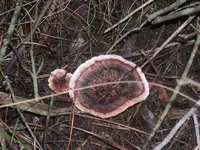
Zoned tooth (Hydnellum concrescens) is a tooth fungus, not a typical leafy plant. It forms dense, often fused rosettes with zoned, concentric bands of brown, gray, and cream on the cap surface.
The underside carries soft, downward-pointing spines instead of gills, giving it a distinctive texture. It usually grows on the ground in coniferous forests across Europe and parts of North America, often among moss and decaying needles.
This species is mycorrhizal, meaning it forms a nutrient-sharing partnership with tree roots, which makes it difficult to cultivate at home. In practice, it is easier to appreciate in the wild than to care for Zoned tooth in a garden or container setting.

Care Difficulty
Hard Care

Light Preference
Partial Shade

Water Requirements
Keep Soil Moist

Temperature Preference
Cool Climate

Hardiness Zone
5–9

Soil Texture
Loamy, Sandy, Organic-rich

Soil pH
Strongly acidic (4.5–5.5), Acidic (5.5–6.5)

Soil Drainage
Moist but well-drained

Fertilization
Minimal (feed rarely)
Scan your plant to receive care tips personalized for your specific plant
Available on iOS and Android
This fungi-like organism prefers cool, shaded forest conditions with limited direct sun exposure.
This mycorrhizal fungus depends on consistently moist, not waterlogged, forest soil.
This species thrives in cool to mild climates typical of temperate forests.
Humidity is not a key controllable factor for Hydnellum concrescens in garden or woodland settings.
Hydnellum concrescens thrives in consistently moist, acidic, organic-rich soil with loose structure.
This species is not suitable for conventional container growing.
Hydnellum concrescens is a mycorrhizal fungus that partners with trees and does not need conventional fertilization.
Hydnellum concrescens does not require structured pruning, but minor cleanup can keep the site tidy and reduce disease risk.
This fungus is best maintained in situ under suitable host trees rather than moved or repotted.
Propagation of Hydnellum concrescens is technically challenging and rarely performed by home growers.
This tooth fungus is naturally cold hardy in its range and generally needs no special winter care.

Plant Health Check
Not sure what's wrong with your plant? Check your plant's health inside the app.
The fruiting body typically shows sharply defined concentric zones of different brown tones on the cap surface, which is one of the key field characters used by mycologists to separate it from closely related Hydnellum species.
This species forms ectomycorrhizal partnerships with conifer roots, especially pines, helping trees access nutrients such as phosphorus while receiving carbohydrates produced by the host via photosynthesis.
Instead of gills or pores, the undersides of the caps bear dense, downward-pointing spines (teeth) from which spores are released, a defining feature of tooth fungi in the family Bankeraceae.

In several European countries, Hydnellum concrescens is considered regionally rare and is included on fungal red lists, and its presence can indicate long-continuity, relatively undisturbed conifer woodland with low nutrient input.
This fungus is generally considered inedible due to its tough, corky texture and very bitter taste. It is not used in cooking and is best treated as a woodland curiosity rather than a food source.
Keep your plants happy and healthy with plant identification, disease detection, and easy care guidance.