Containment management
Use shallow trays, floating rings, or marginal baskets to confine spread and make it easy to remove excess growth before it shades out other aquatic plants or clogs filters.

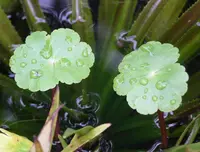
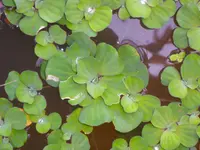
Floating marshpennywort (Hydrocotyle ranunculoides) is an aquatic or semi-aquatic perennial that forms dense mats of round, scalloped leaves on creeping stems. It often floats on or edges slow-moving water bodies such as ponds, ditches, and wetland margins in parts of North America, South America, and Europe.
The plant grows quickly by stolons, which are horizontal stems that root at the nodes, making it vigorous and sometimes invasive in suitable conditions. Its fast growth and spreading habit mean it can be easy to establish but must be controlled in small ponds or containers. To care for floating marshpennywort, provide consistently wet conditions, moderate to bright light, and nutrient-rich, silty or muddy substrate if grown rooted rather than freely floating.

Care Difficulty
Moderate Care

Light Preference
Full Sun

Water Requirements
Aquatic

Temperature Preference
Cool Climate

Hardiness Zone
5–10

Soil Texture
Loamy, Silty, Organic-rich

Soil pH
Slightly acidic (6.5–7.0), Neutral (7.0)

Soil Drainage
Waterlogged tolerant

Fertilization
Minimal (feed rarely)
Scan your plant to receive care tips personalized for your specific plant
Available on iOS and Android
This shallow-water plant prefers bright conditions but is sensitive to harsh, drying sun.
Hydrocotyle ranunculoides is an aquatic or marginal plant that expects constant moisture rather than periodic drying.
This species grows best in mild conditions and suffers in both hard frost and extreme heat.
This species prefers consistently high humidity similar to marshy edges or shallow water.
Hydrocotyle ranunculoides grows best in saturated, organic-rich substrates that mimic slow-moving or still water margins.
This species is suitable for container culture, especially in tubs, water gardens, and marginal pond planters.
Hydrocotyle ranunculoides benefits from light, consistent nutrition but is sensitive to overfeeding in contained systems.
Hydrocotyle ranunculoides responds well to light, frequent trimming that manages spread and keeps foliage dense.
Hydrocotyle ranunculoides is usually managed by transplanting or thinning patches rather than classic repotting.
Hydrocotyle ranunculoides is commonly propagated vegetatively to maintain vigorous, uniform colonies.
Hydrocotyle ranunculoides is fairly cold tolerant in many temperate ponds but may die back where winters are harsh.

Plant Health Check
Not sure what's wrong with your plant? Check your plant's health inside the app.
This species can spread quickly across still or slow-moving freshwater, forming dense floating mats that shade out submerged plants and alter light and oxygen levels in the water column.
Its creeping stolons and buoyant, petiolate leaves allow the plant to root in shallow margins while extending out over open water, effectively exploiting both terrestrial and aquatic zones.
Native to the Americas, it has become a problematic invasive species in several regions of Europe and elsewhere, where its dense growth clogs waterways and interferes with recreation and water management.

In some countries, strict regulations control the sale, transport, and intentional introduction of this species because even small fragments of stem can regenerate into new plants and start new infestations.
This species spreads very quickly by creeping stems that root at the nodes, forming dense mats on the water surface. Regular thinning and physical removal are essential to prevent it from crowding out other aquatic plants and blocking light.
Keep your plants happy and healthy with plant identification, disease detection, and easy care guidance.