Mark Dormant Clumps
Flag the planting area with small markers before foliage dies back in late summer so you do not accidentally disturb the bulbs when cultivating or planting nearby perennials later in the year.

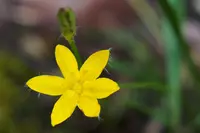
Yellow star grass (Hypoxis hirsuta) is a small, herbaceous perennial often found in open woods, prairies, and meadows across much of North America. It forms low clumps of narrow, grass-like leaves that create a simple, tufted look near ground level.
In spring to early summer it produces bright yellow, star-shaped flowers held just above the foliage, opening in sun and closing in shade or at night. It is generally considered easy to grow if given sun, well-drained soil, and moderate moisture.
For gardeners learning how to care for yellow star grass, the main factors are avoiding soggy conditions and protecting it from heavy foot traffic or aggressive groundcovers.

Care Difficulty
Easy Care

Light Preference
Full Sun

Water Requirements
Moderate Water

Temperature Preference
Cold Hardy

Hardiness Zone
3–9

Soil Texture
Sandy, Loamy, Organic-rich

Soil pH
Acidic (5.5–6.5), Slightly acidic (6.5–7.0)

Soil Drainage
Well-drained

Fertilization
Minimal (feed rarely)
Scan your plant to receive care tips personalized for your specific plant
Available on iOS and Android
This small perennial thrives in open, sunny sites but tolerates some light shade, especially in hot summers.
This woodland-edge wildflower prefers moderately moist, well-drained soil that never stays saturated for long.
This hardy perennial tolerates a wide temperature range but grows best in mild spring and early summer conditions.
Humidity is not a key factor for Hypoxis hirsuta, which adapts well to typical outdoor air levels.
Hypoxis hirsuta prefers light, well-drained, moderately fertile soil that mimics open meadow or prairie conditions.
This species can be grown in containers if the pot mimics its shallow, free-draining native habitat.
This small native bulb usually needs minimal feeding, especially in naturalized or meadow plantings.
Hypoxis hirsuta needs only light pruning focused on tidiness and plant health.
This species is more often transplanted in garden beds than kept as a long-term container plant.
Propagation of Hypoxis hirsuta is usually done by seed or gentle division of established clumps.
This hardy native bulb tolerates typical winter conditions in much of its range and usually needs little special care.

Plant Health Check
Not sure what's wrong with your plant? Check your plant's health inside the app.
The narrow leaves are densely covered with fine hairs that can give the plant a silvery or grayish cast in strong light, which likely helps reduce water loss and glare in its open, sunny habitats.
Its bright yellow, star-shaped flowers typically open in sunny conditions and close in shade or at night, an energy-saving strategy that also times pollen availability with peak pollinator activity and is central to Hypoxis hirsuta plant care in full-sun gardens.
The plant survives winter and drought through a small underground corm, a swollen storage stem that allows it to go dormant above ground and resprout reliably each growing season.

In parts of its native North American range, this species can function as a conservative indicator plant, meaning it is most often found in relatively undisturbed prairie and savanna remnants with long ecological continuity.
This species forms small clumps and slowly expands by short rhizomes and self-seeding. It usually stays patchy rather than forming dense mats, so it is not considered aggressive in typical garden conditions.
Keep your plants happy and healthy with plant identification, disease detection, and easy care guidance.