



yaupon holly Identification (Ilex vomitoria)

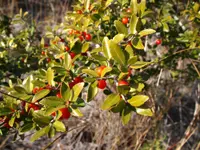
Recognize yaupon holly by its small, alternate, oval leaves with shallow rounded teeth mostly near the tip, usually under 2 inches (5 cm) long.

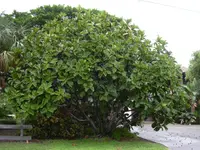
It grows as a densely branched evergreen shrub or small tree with many slender gray twigs and a smooth, pale gray trunk on older plants.

Ilex vomitoria Identification

Scan to Confirm yaupon holly

Upload a clear image to check whether your plant ID is correct.

Clear images work best. Avoid photos taken too close or too far away

Use these quick visual traits to check the plant by eye.

  • Leaves are small, simple, and alternate, usually 1 to 2 inches (2.5 to 5 cm) long.
  • Leaf edges are shallowly scalloped or rounded-toothed rather than sharply spiny.
  • Twigs are slender, and the plant often forms a dense, many-branched shrub or small tree.
  • Trunks are commonly multiple from the base, with smooth pale gray bark on older stems.
  • Fruits are round, bright red berries held singly in the leaf axils along the stems.

Check several branches, since leaf size and density can vary on the same plant.

Ilex vomitoria shows clear visual shifts from a small shrublet to a fruiting woody shrub.

  • Seedling: Seedlings have thin green stems and a few alternate, simple leaves that are smaller, softer, and less densely packed than on older plants.
  • Young plant: Young plants form many twiggy branches from low on the stem, creating a compact outline; leaves thicken and reach about 1 inch (2.5 cm) long.
  • Mature plant: Mature plants develop a denser crown and stronger woody framework, often becoming a rounded shrub or small tree 15 to 25 feet (4.6 to 7.6 m) tall.
  • Fruiting stage: Fruiting branches show small, round red drupes held close along the stems, making female plants visibly different from nonfruiting or male plants.

Several named selections of yaupon holly are easy to separate by habit and leaf color.

  • 'Nana': A dwarf, mounded form that usually stays under 4 feet (1.2 m) tall, with a dense, rounded outline much smaller than the typical shrub or small tree.
  • 'Schillings Dwarf': A very compact clone with tiny leaves and a tight, low dome, often about 3 to 4 feet (0.9 to 1.2 m) tall and wider than high.
  • 'Pendula': Shows a strongly weeping habit, with arching to drooping branches instead of the usual upright to spreading crown.
  • 'Aureo Marginata': Has variegated leaves with yellow to creamy yellow margins, unlike the typical solid green foliage.

Yaupon holly stays evergreen, so it usually keeps its small, leathery leaves through winter. That helps separate it from deciduous hollies when nearby shrubs are bare. In spring, small pale flowers become visible in the leaf axils, where leaves meet the stem. By fall into winter, female plants often show bright red berries that can persist after cool weather begins.

Several evergreen shrubs can be mistaken for yaupon holly at a glance.

inkberry(Ilex glabra)

Similar because both are broadleaf evergreens with small oval leaves and dark berries. Inkberry usually has leaves clustered toward branch tips and mostly smooth margins; yaupon holly more often shows fine rounded teeth along the leaf edge.

Japanese holly(Ilex crenata)

Often confused because it also has tiny evergreen leaves and a dense shrub form. Japanese holly has flatter, more regularly crenate leaf margins and a more uniform, twiggy texture; yaupon holly usually shows slightly thicker leaves and a less even outline.

Ilex vomitoria is native to the southeastern United States, from Virginia south through Florida and west to Texas and Oklahoma. Knowing that range helps separate it from similar hollies seen outside the Southeast, especially in natural settings. In the wild it occurs in coastal dunes, maritime forests, sandy woodlands, pine flatwoods, and stream edges, often on well-drained sandy soils but also in seasonally wet sites. Finding it in coastal or near-coastal habitats is a useful identification clue.

  • Berries and leaves: Ingestion is the main concern. The berries and leaves contain caffeine-like methylxanthines and can cause vomiting and other stomach upset in humans and pets if eaten.
  • Children and pets: Bright red berries can attract children and animals. Risk relates to swallowing the fruit, not skin contact. Dogs and cats may develop gastrointestinal upset after eating berries or leaves.

Check Your Plant ID

Use Botan to identify or confirm the plant from a photo, which helps avoid mix-ups with similar species.

FAQ

Yes. Identifying yaupon holly usually relies on its small evergreen leaves, alternate leaf arrangement, smooth to finely scalloped margins, and many short twigs on pale gray stems. Flowers help, but they are not required.

More Plant Identification Guides

Identify Your Plant and Learn More

Use Botan to identify it from a photo, then get plant details, care information, and common problems for that species.

Botan app identifying a plant from a photo
Best Time to Mow Lawn – A Complete Guide

5 min read · 10 Aug 2026

Best Time to Mow Lawn – A Complete Guide

Explore when to mow your lawn for its health and a pleasant green color. Find out the best time for this task during the summer heat, and follow practical tips for correctly cutting the grass, and learn common mistakes to avoid.

Plant Care
Best Time to Mow Lawn – A Complete Guide
Planting Grass Seed in Summer – What Works and What Fails

7 min read · 6 Aug 2026

Planting Grass Seed in Summer – What Works and What Fails

Summer seeding succeeds when the grass type suits the season, and the soil stays moist. Find out how to prepare the seedbed and choose a safe window for planting.

Plant Care
Planting Grass Seed in Summer – What Works and What Fails
How to Use a Moisture Meter for Plants

5 min read · 4 Sept 2026

How to Use a Moisture Meter for Plants

Watering by feel kills plenty of houseplants. A moisture meter checks the soil for you, and takes the guesswork out of it. This guide will show you how to use it correctly, from the first touch to the final reading.

Beginner Guides
How to Use a Moisture Meter for Plants