Pinch For Bushiness
Pinch out the soft shoot tips when plants are 10–15 cm tall to encourage branching and produce more flowering stems instead of one tall, weak stalk.

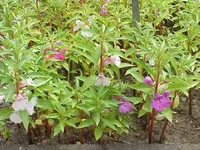
Garden balsam, Impatiens balsamina, is a fast-growing annual flowering plant commonly used in summer beds, borders, and containers. It forms bushy, upright clumps with juicy, translucent stems and soft, lance-shaped leaves.
Flowers are usually pink, red, white, or purple and appear along the stems, often partly hidden by foliage. Many forms have double or semi-double blooms that give a full, ornamental look.
This species is native to tropical and subtropical Asia, where it thrives in warm, humid conditions. It tends to be easy to grow in gardens with moist, well-drained soil and partial sun to light shade.
Seeds germinate readily and may self-sow, which helps beginners care for Garden balsam with minimal effort in suitable climates.

Care Difficulty
Moderate Care

Light Preference
Partial Sun

Water Requirements
Keep Soil Moist

Temperature Preference
Tropical / Frost Sensitive

Hardiness Zone
10–11

Soil Texture
Loamy, Silty, Organic-rich

Soil pH
Acidic (5.5–6.5), Slightly acidic (6.5–7.0)

Soil Drainage
Moist but well-drained

Fertilization
Light (every 4–6 weeks)
Scan your plant to receive care tips personalized for your specific plant
Available on iOS and Android
Impatiens balsamina grows best with gentle, indirect light and protection from harsh sun.
This species prefers evenly moist, not soggy, soil throughout the growing season.
This warm-season annual performs best in stable, mild to warm temperatures.
This species prefers moderate air moisture and reacts quickly to very dry conditions.
Impatiens balsamina grows best in loose, moist, organic-rich soil that drains freely but does not dry out fast.
This species is very suitable for container growing when moisture and drainage are carefully managed.
Impatiens balsamina responds well to light, consistent feeding during its active growing season.
Pruning Impatiens balsamina is mainly about keeping plants tidy and encouraging compact, floriferous growth.
This fast-growing annual is usually transplanted rather than long-term potted, so focus on gentle handling of its roots.
Impatiens balsamina is most often propagated from seed, which allows rapid production of many plants.
This species is a tender annual in most climates and does not survive true winter outdoors.

Plant Health Check
Not sure what's wrong with your plant? Check your plant's health inside the app.
The ripe seed pods build up internal tension as they mature and burst open at the slightest touch, catapulting the seeds several feet away. This rapid movement is caused by the mechanical release of stored elastic energy in the pod walls, a classic example of ballistic seed dispersal.
Its showy petals are relatively short-lived and often drop soon after heavy rain or strong watering, a trait linked to their delicate, thin cell structure. This rapid petal loss helps the plant conserve resources and reduce fungal problems on aging floral tissue.
The species is native to South and Southeast Asia but has been cultivated as an annual ornamental in Europe and North America since at least the 17th–18th centuries. Early botanical collections and trade routes helped spread it widely into gardens long before many modern bedding plants were developed.

In parts of East and South Asia, crushed flowers of this species have been traditionally used as a natural dye to stain fingernails and sometimes skin or fabrics, providing a plant-based colorant long before synthetic nail polishes became common.
Yellowing leaves usually result from overwatering, poor drainage, or nutrient deficiency, especially nitrogen. Check that the pot drains freely, let the topsoil dry slightly between waterings, and use a balanced fertilizer at low strength during active growth.
Keep your plants happy and healthy with plant identification, disease detection, and easy care guidance.