Early trellis training
Install a sturdy trellis or netting before vines reach 15–20 cm, then gently wrap new stems around the support every few days to encourage vertical growth and prevent tangling on nearby plants.

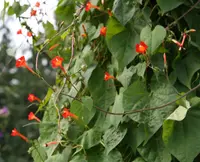
Ipomoea coccinea, commonly called redstar or red morning glory, is a twining annual vine in the bindweed family. It is grown mainly for its small, bright red, star-shaped flowers. The plant climbs by wrapping slender stems around supports and can quickly cover fences, trellises, or other structures in warm weather. Its heart-shaped leaves and airy growth give a light, informal look. Redstar is native to tropical and subtropical regions of the Americas but has naturalized in many warm-temperate areas. It tends to be easy to grow from seed, though it can self-seed readily. To care for redstar, provide full sun, well-drained soil, and moderate, consistent moisture without waterlogging.

Care Difficulty
Easy Care

Light Preference
Full Sun

Water Requirements
Moderate Water

Temperature Preference
Tropical / Frost Sensitive

Hardiness Zone
9–11

Soil Texture
Sandy, Loamy, Organic-rich

Soil pH
Acidic (5.5–6.5), Slightly acidic (6.5–7.0)

Soil Drainage
Well-drained

Fertilization
Minimal (feed rarely)
Scan your plant to receive care tips personalized for your specific plant
Available on iOS and Android
Ipomoea coccinea performs best with strong, direct light in most climates.
Water needs for Ipomoea coccinea are moderate once the plant is established.
This species prefers warm, frost-free conditions throughout its growing season.
This vine handles a wide humidity range and usually does not need special redstar indoor care adjustments.
Ipomoea coccinea prefers light, well-drained soil that does not stay wet for long.
This species grows well in containers when given adequate root space and support for climbing.
Ipomoea coccinea grows best with light, balanced feeding during the warm growing season.
Ipomoea coccinea responds well to modest, targeted pruning that guides growth and flowering.
This vine is usually grown outdoors and is more often transplanted in beds than repotted in containers.
Ipomoea coccinea is most commonly propagated from seed, which germinates quickly in warm conditions.
In most climates this vine is grown as a tender annual, so winter care focuses on soil and seed rather than the top growth.

Plant Health Check
Not sure what's wrong with your plant? Check your plant's health inside the app.
In its native range, scarlet morning-glory flowers are frequently pollinated by long-billed hummingbirds that match the narrow tubular corolla, an example of floral traits evolving alongside specific bird pollinators.
This species completes its life cycle in a single growing season and climbs by twining its stems around nearby supports rather than using tendrils or adhesive roots.
The plant produces small red, star-shaped blooms only about 1–2 cm across, which open during daylight and close later in the day, concentrating nectar access into a limited time window for pollinators.

Genetic and morphological studies indicate that this species belongs to a closely related group of red-flowered morning-glories, and it has sometimes been confused with or lumped into Ipomoea hederifolia in older botanical literature, so accurate identification often depends on fine details of leaf shape and flower structure.
Poor flowering usually results from insufficient light, low nutrients, or plants started too late in the season. Ensure a long, warm growing season, avoid excess nitrogen fertilizer, and deadhead spent blooms so energy goes into producing new flowers.
Keep your plants happy and healthy with plant identification, disease detection, and easy care guidance.